Economic Change: Italy
While early modern Italy was a prominent center of European economics during the peak of the Renaissance, the ensuing centuries are marked by political complexities, disunification, and European colonial powers expanding while Italy’s economy remained relatively stagnant and grounded in agriculture. Prior to the Thirty Years War, Italy thrived as a hub for luxury goods, handcrafted through tight-knit guilds and traded within a dense network of cities. The Medici family, exemplified by Lorenzo de Medici, emerged as pivotal figures in Italy’s politics, culture, and economy. Lorenzo's patronage of the arts is an example of the flourishing of the Renaissance, with his circle of poets and artists contributing to an explosion of creative genius.
The expansion of the printing press added another layer to Italy's economic narrative. Combined with the Renaissance’s rediscovery and appreciation of classical texts, the printing press allowed the spread of ideas that were formerly only available to the wealthy elite. This conduit of dissemination gradually allowed education through books to become a tangible part of life in medium-sized towns and merchant families, laying the foundation for the development of the middle class. In addition, the printing press is emblematic of the technological revolutions in this period that connected Italy with the broader European landscape.
However, the decline in maritime trade, industrial production, and the devastating effects of war ushered in a period of economic recession. The once-thriving Florentine woolen industry saw a significant reduction of its production, reflecting the broader economic downturn faced by Italian cities. Attempts to tighten trade restrictions only worsened the situation. Many Italian states were under Spanish Habsburg control and struggled with the financial burdens imposed upon them, leading to increased taxation and strained agricultural productivity. Spain's bankruptcy in 1627 only intensified the financial strain on Italian states.
The seventeenth century was marked by economic struggles for Italy. Wages decreased throughout the century, the monopoly in Levant markets was lost, and the proto-industrialization process saw the decay of urban industry. Cheaper foreign textiles challenged traditional high quality Italian products and shipbuilding declined after the Dutch and English began to dominate maritime trade in Italian ports. Silver shipments from the New World drastically inflated the money supply in Europe (the Price Revolution) and these increased prices were not matched by higher wages or rents in Italy as “The credit shock of the second decade of the seventeenth century and the outbreak of the Thirty Years war burst the bubble of the Italian boom” (Kuehn 2002). In addition, typhus hit Genoa, Milan, and many other Italian cities exceptionally hard in the middle of the seventeenth century. By 1680, Italy had undergone a substantial economic reconfiguration, shifting from an exporter to an importer as its economy was now service based instead of manufacturing based and much urban production transferred to the countryside.
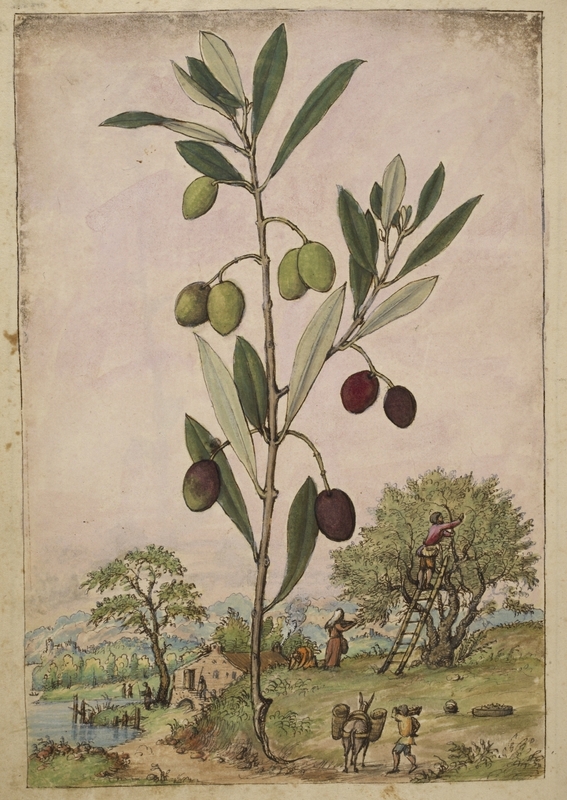
Nonetheless, Gherardo Cibo’s olive plate serves as a reminder of Italy's agrarian roots and how its agricultural economy, though challenged, remained a steadfast foundation through the seventeenth and eighteenth centuries. In fact, agriculture was one of the few sustaining forces through the turbulence of war and economic decline. Simultaneously, the distinct form of slavery in Italy added another layer to its economic tapestry. Regional differences in the acceptance of slavery, as seen in the anecdote of Giorgio and Andrea, influenced Italy's economic trajectory, distinguishing it from other European nations that experienced massive growth in this period that was heavily reliant on the slave trade and colonialism.
In summation, Italy's economic history during the early modern period is a tale of resilience, cultural brilliance, and economic adaptation. War was extremely detrimental to the Italian economy, which struggled to reinvigorate itself, in part due to the disunification of Italy’s states. Ultimately, The Medici's patronage of the arts, the expansion of the printing press, the agricultural foundation, and the complex dynamics of slavery all played integral roles in shaping Italy's economic destiny amid the challenges and opportunities of this era.