Olive Illustration
Item
-
Title
-
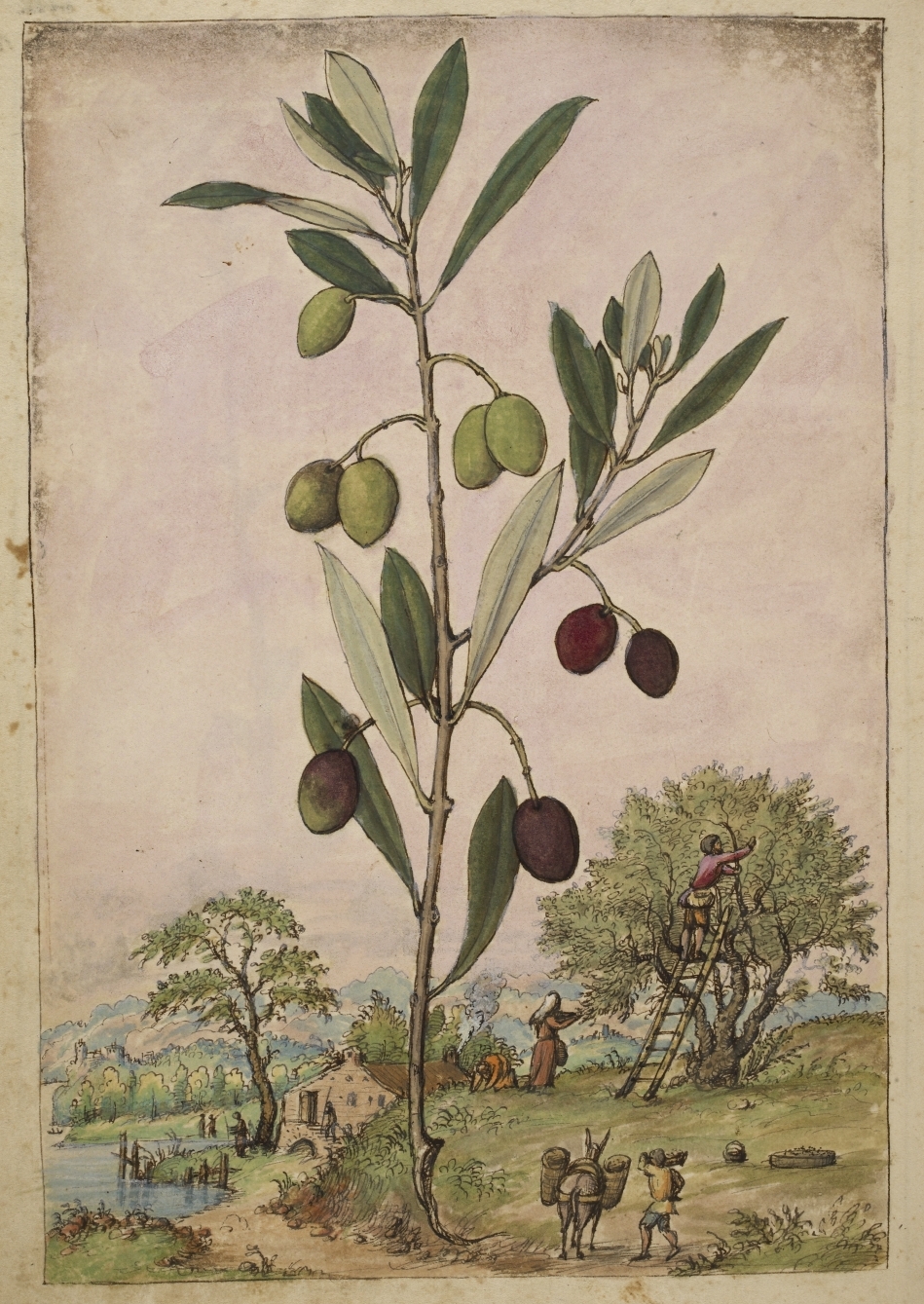
Olive Illustration
-
Creator/author/artist of the original item
-
Gherardo Cibo
-
Date
-
1568
-
Description
-
This 16th century plate of the branch of an olive tree (Olea europaea) was illustrated by Gherardo Cibo, an Italian artist and herbalist. It is taken from a work of herbal medicine, *Discorsi on Dioscorides' De Materia Medica* by Pietro Andrea Mattioli, first published in Italy in 1554. *De Materia Medica* is a first century encyclopedia of herbal medicine by Dioscorides, a Greek botanist/physician. In addition to its main olive branch, this plate depicts a typical image of contemporary Italian agriculture in the background. Until the Risorgimento in the nineteenth century, Italy was a predominantly agrarian economy based in dry farming with little irrigation. The Italian soil and climate did not sustain heavy horses and plows well so “Manpower and the hoe, rather than horsepower and the plough, limited the productive capacity of the land” (Kuehn 2002). Traditional Italian crops included cereals, vines, and olive/fruit trees. However, in the sixteenth and seventeenth centuries, mulberry trees, silkworms, maize, and rice (mostly just in Northern Italy) also became critical. Because the agrarian calendar kept agricultural workers seasonally under-employed and women workers often in the home, low wages and piece rates could keep production costs down. Proto-industrialization, or the putting out system, transferred industries to the rural countryside and “took advantage of cheap peasant labour” (Kuehn 2002). As the main source for heat, fuel, cooking, and construction, wood and forests were an essential part of Italy’s pre-industrial economy as well. After 1550, promiscuous culture exploded in popularity and helped increase yield, raise soil temperatures, and extend the growing season. Promiscuous culture is a multi-crop system coming from the Romans where the interplanting of understory and overstory crops is used to help save labor, smother weeds, and shield the ground all year. In addition, the Mezzadria sharecropping system was prominent in this period. A Mezzadria was a contract between a proprietor of land (padrone) and a laborer (mezzadro) which often involved intense labor and saw the laboring families end up in debt (Hanlon 2000). While Renaissance era Italy had been a source of economic power in Europe thanks to “banking, organized business procedures, and large-scale cloth production,” this was no longer the case in the early modern period (Wiesner-Hanks 487). While Northwestern Europe witnessed dramatic economic expansion thanks to technological innovations, urbanization, and dense networks of exchange, Italy remained grounded in agriculture and hindered by its disunification. By the eighteenth century, “Genoa and Venice had been eclipsed by Amsterdam and London” (Wiesner-Hanks 487).
-
Place
-
Marche, Italy
-
Source Citation
-
Wiesner-Hanks, Merry E. *Early Modern Europe, 1450-1789*. 3rd ed. of *Cambridge History of Europe*. Cambridge: Cambridge University Press, 2022.
-
Mattioli, Pietro Andrea. *Discorsi on Dioscorides' De Materia Medica*, Venice, Italy, 1554.
-
Rights / License
-
Public Domain
 Olive Illustration