-
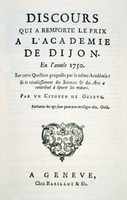 Discourse on the Arts and Sciences
 A massively controversial debut, Jean-Jacques Rousseau’s “Discourse on the Arts and Sciences” burst onto the scene in 1750, winning an essay contest sponsored by the Academy of Dijon on “whether the restoration of the Sciences and the Arts has contributed to the purification of morals.” This prompt illustrates a common Enlightenment narrative. The “restoration of the Sciences and the Arts” speaks to Renaissance humanism and the rediscovery of classical texts, which was commonly framed in this period as a sharp break from the prior “dark ages,” bringing about technological, scientific, and cultural innovations. However, Rousseau’s discourse took a strong, unpopular stance against the moral benefits of the popularization of the arts and sciences. Moreover, this essay serves to exemplify the stage for intellectual disagreement that became prominent in the Enlightenment. Along with furious debate and investigation among intellectuals, this period saw the rise of the public sphere, where citizens gradually became increasingly invested in politics, philosophy, science, and more. Rousseau argues that modernity has forced people to live insincerely, engendering a smallness of soul within them. Examining modern society, Rousseau explicates how citizens see themselves as rational pursuers of self-interest (beginning with Machiavelli’s break from the high-minded and abstract “virtue” of classical political philosophy). Figures like Locke and Hobbes, writing after one of the deadliest periods of religious strife in European history, sought to ground society in self-interest and create institutions that could guide a rational citizenry to minimize violence and incentivize the “common good.” In stark contrast, Rousseau vividly paints a dispiriting portrait of a society where the thing one wants the most is to swindle their neighbor, for there is no legitimate profit that cannot be outdone by an illegitimate profit. The only thing preventing one from conquering their peers is the law, the institutions that citizens begrudgingly agree to follow out of fear. Even though the restoration of the arts and sciences has brought about great discoveries about the orbits of the heavenly bodies, Rousseau asks if mankind is better governed or more virtuous because of this. Interestingly, Rousseau does not argue entirely against the arts and sciences, but rather against their popularization. Near the end of his discourse, he describes how brilliant minds like Bacon, Newton and Descartes, “Preceptors of Mankind,” should pursue the sciences and the arts, but should not share their findings with the public (Rousseau 59). It is in the dissemination of their findings and the visible rewards and praises of these figures, that Rousseau observes corruption. These are the sources of the dogmatic embrace of skepticism and reason that Rousseau finds in so many “pseudo-intellectuals” and sophists who parade around undermining the foundations of morality like religion and love of the fatherland (grounded in customs and beliefs, not reasoning). Whatever a society rewards, it inherently encourages, and Rousseau sees himself surrounded by people who are widely honored and massively wealthy thanks to their talents as writers, artists, etc., regardless of the quality of their character. This encourages people to pursue money and glory rather than virtue. Ultimately, Rousseau’s “Discourse on the Arts and Sciences” set the foundation for his political project, the legacy of which is deeply complex and played a major part in political revolutions (especially the French Revolution). Much like Rousseau, the Enlightenment shares a complicated legacy. While many movements of the nineteenth, twentieth, and twenty-first century used Enlightenment concepts in their efforts to expand the rights of different groups, it is critical to note that “The Enlightenment has been seen as both a liberating movement that resulted in the revolutions of the later eighteenth century, and an authoritarian movement that justified racism and European imperial domination” (Wiesner-Hanks 389).
-
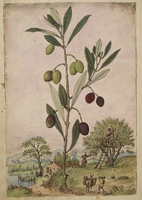 Olive Illustration
 This 16th century plate of the branch of an olive tree (Olea europaea) was illustrated by Gherardo Cibo, an Italian artist and herbalist. It is taken from a work of herbal medicine, *Discorsi on Dioscorides' De Materia Medica* by Pietro Andrea Mattioli, first published in Italy in 1554. *De Materia Medica* is a first century encyclopedia of herbal medicine by Dioscorides, a Greek botanist/physician. In addition to its main olive branch, this plate depicts a typical image of contemporary Italian agriculture in the background. Until the Risorgimento in the nineteenth century, Italy was a predominantly agrarian economy based in dry farming with little irrigation. The Italian soil and climate did not sustain heavy horses and plows well so “Manpower and the hoe, rather than horsepower and the plough, limited the productive capacity of the land” (Kuehn 2002). Traditional Italian crops included cereals, vines, and olive/fruit trees. However, in the sixteenth and seventeenth centuries, mulberry trees, silkworms, maize, and rice (mostly just in Northern Italy) also became critical. Because the agrarian calendar kept agricultural workers seasonally under-employed and women workers often in the home, low wages and piece rates could keep production costs down. Proto-industrialization, or the putting out system, transferred industries to the rural countryside and “took advantage of cheap peasant labour” (Kuehn 2002). As the main source for heat, fuel, cooking, and construction, wood and forests were an essential part of Italy’s pre-industrial economy as well. After 1550, promiscuous culture exploded in popularity and helped increase yield, raise soil temperatures, and extend the growing season. Promiscuous culture is a multi-crop system coming from the Romans where the interplanting of understory and overstory crops is used to help save labor, smother weeds, and shield the ground all year. In addition, the Mezzadria sharecropping system was prominent in this period. A Mezzadria was a contract between a proprietor of land (padrone) and a laborer (mezzadro) which often involved intense labor and saw the laboring families end up in debt (Hanlon 2000). While Renaissance era Italy had been a source of economic power in Europe thanks to “banking, organized business procedures, and large-scale cloth production,” this was no longer the case in the early modern period (Wiesner-Hanks 487). While Northwestern Europe witnessed dramatic economic expansion thanks to technological innovations, urbanization, and dense networks of exchange, Italy remained grounded in agriculture and hindered by its disunification. By the eighteenth century, “Genoa and Venice had been eclipsed by Amsterdam and London” (Wiesner-Hanks 487).
-
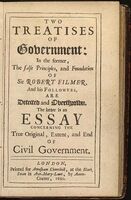 Two Treatises of Government
 John Locke’s *Two Treatises of Government* was a major work of political philosophy that refuted the theory of the divine right of kings and set the stage for the emergence of the middle class. Locke’s writings, however, can only be properly understood in the context of 17th century European politics. After the death of Queen Elizabeth I in 1603, her cousin James I succeeded her. Lacking the tactical adeptness of his predecessor, James’ tenure was marked by struggles with Parliament about spending, marriages, and religion. By the time Charles I took over in 1625, the country was increasingly divided and his leadership only worsened matters. Eventually, tensions between Parliament and the Crown boiled over into civil war and Charles I was executed in 1649. Until 1660, England was in a period of Interregnum, in which they attempted various forms of republican government. However, when Oliver Cromwell passed away, his son Richard succeeded him as Lord Protector and did not have the power base between Parliament and the military to lead. Thus, the crown was restored with the son of Charles I, Charles II. But when Charles II died in 1685, the throne fell to his brother James II. Since James II was Catholic, the English were very opposed to his succession, resulting in the Glorious Revolution of 1688, which deposed James II and installed the Protestant William III and Mary II, confirming the primacy of Parliament over the Crown. Beyond just defending the Glorious Revolution, Locke’s writings established a new understanding of the purpose of government. Perhaps even more importantly, Locke’s project of political philosophy helped change individual citizens’ understanding of their relationship to their rulers. Drawing on the authority of God and examining the conditions of humans living in their ‘natural state’ before entering into societies and forming governments, Locke asserts that all people have property (including both the things one possesses as well as one’s “life, liberty, and estate, which he describes, somewhat vaguely, as ‘natural rights’ given to humans by God”) that they are naturally inclined to protect and improve (Wiesner-Hanks 383). For Locke, one can attain a natural right to an object of nature when they mix their labor with it (e.g. when a person cultivates a field, they have earned the right to that property and the fruits of its harvest). Since God commanded men to cultivate the earth, people should ‘improve’ the Earth by being industrious and rational, pursuing the expansion of their property and increasing the productivity of the Earth. Society, therefore, is an agreement among individuals in the state of nature who decide to sacrifice some of their natural freedoms in order to pursue the expansion of one’s property with a general network of protection and recourse in the event of disagreements, which all too easily become wars in the state of nature where nothing prevents one person from conquering another. This is a starkly distinct understanding of one’s purpose in life that minimizes the influence of the religious sects, “noble aristocrats,” and monarchs responsible for many of the problems of Locke’s times. Instead, after the brutal religious strife that decimated Europe in the 17th century, Locke is valorizing work, reason, and personal happiness, arguing that the purpose of government is to increase population and encourage industrious behavior.
-
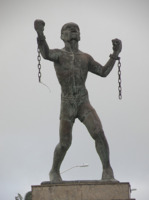 The Emancipation Statue ('Bussa')
 *The Emancipation Statue* is a public sculpture in Barbados that depicts the leader of a slave rebellion in 1816 valiantly breaking his chains in an expression of his humanity. Created in 1985 by Bajan sculptor Karl Broodhagen, the bronze statue is often called ‘*Bussa*,’ the name of an enslaved person who actually helped inspire the 1816 revolt. This statue highlights the impact of slavery on the history of Barbados, one of many places in the ‘New World’ that would be dramatically altered by the “European voyages, trading ventures, and colonization” of the 16th and 17th centuries (Wiesner-Hanks 291). Between 1625 and 1807, about 2.7 million enslaved Africans were brought to the British Caribbean. More than 500,000 enslaved Africans were brought to Barbados alone, an island of just 166 square miles. By 1680, Barbados was the richest, most populous, and most highly developed colony in British America and by the late 1770s, the average white person in the British West Indies was making over ten times as much money as the average white person in other parts of the British Empire, including England (Brueckmann 2024). Beyond Barbados though, Europe’s colonization of the ‘New World’ also “encouraged warfare, siphoned off productive workers, and destroyed kinship groups” on the west coast of Africa (Wiesner-Hanks 291). In addition, “the Spanish quickly conquered the large and prosperous Aztec and Inca empires” in the Americas thanks to “the rapid spread of European diseases” which ultimately killed most of the indigenous population in many places (Wiesner-Hanks 291). The ‘New World’ would soon be characterized by agricultural plantations, Christian churches, and diverse populations that included Europeans, Africans, and Indigenous peoples. It is critical to note the impact on this period of the widespread, insidious, and ethnocentric perspective that Europeans were superior to the indigenous peoples they encountered and were therefore ‘liberating’ these peoples from their backwards ways.
-
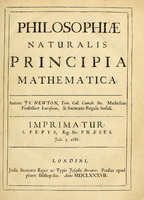 Philosophiæ Naturalis Principia Mathematica or The Principia
 Pictured here is the title page of the first edition of Sir Isaac Newton's *Philosophiæ Naturalis Principia Mathematica* (or *Mathematical Principles of Natural Philosophy*). It was published on July 5, 1687 and introduced Newton's laws of motion as well as his law of universal gravitation. Often simply called *The Principia* Newton's book comprises three volumes and was written in Latin. Newton had been a student, and then professor, of mathematics at Cambridge and had studied mechanics and cosmology, even building the first working reflecting telescope. In addition, Newton’s development of calculus set the foundation for the majority of modern engineering, physics, and mathematics. *The Principia*, however, was Newton’s most famous work as it brilliantly synthesized Kepler’s findings regarding motions in the heavens and Galileo’s discoveries about motion on earth into universal laws expressed in mathematical terms. Newton went on to be elected to Parliament multiple times and become president of the Royal Society. In the eighteenth century, his ideas began to be applied to the study of heat, light, magnetism, and electricity. It is also important to contextualize Newton’s achievements in the backdrop of the Scientific Revolution, a “time of change in the way learned individuals approached, conceptualized, and studied the natural world” (Wiesner-Hanks 385). This period saw people all over Europe inventing equipment that is still used in laboratories today (beakers and balance scales) while also experimenting with chemical changes and the application of alcohols and acids (often rooted in alchemy). The discoveries of Kepler, Galileo, and more served as major contributions to Newton’s ideas and it is crucial to note how the broader ideological shifts leading up to Newton included critical developments such as the English philosopher and statesman Francis Bacon’s formulation of the scientific method, a sterling example of the contemporary notions of empiricism and the rejection of dogmas.
-
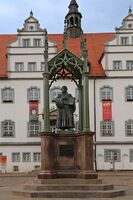 Martin Luther Monument
 Pictured here is the oldest monument dedicated to Martin Luther, located in Wittenberg, Germany. Unveiled in 1821, it was designed by Johann Gottfried Schadow and is similar to several subsequent Luther statues that present him in a castle structure in order to nod to his prominent hymn “Ein feste Burg ist unser Gott” (“A Mighty Fortress Is Our God”). Wittenberg is a key place in the history of the Reformation as Luther was a professor of theology at Wittenberg University. A major part of Luther’s lore as a hero of religious freedom is the story of how he posted his Ninety-Five Theses upon the door of the Castle Church on October 31, 1517. In truth, Luther’s first serious action against the church was his letter to Archbishop Albert of Brandenburg, written in the form of ninety-five theses. Although later biographies claimed he had boldly nailed these theses to the door of the Castle Church, Luther’s theses were written in Latin for an audience learned in theology, making them fairly inaccessible to the ordinary church-goer (Wiesner-Hanks 168). Nonetheless, Luther’s writings decried the Catholic Church’s hypocrisy, corruption, and practice of selling indulgences (certificates that could be purchased in order to reduce the punishment for sins in purgatory) while emphasizing following the scripture before institutions like the church with human actors that can be corrupted. Ultimately, Luther’s efforts turned into a movement (in no small part thanks to the innovation of the printing press) and Europe found itself embroiled in an internal conflict as “Protestant and Catholic political authorities all thought that their territories should have one official state church” and groups who “were considered radical…were intensely persecuted and often forced to flee from one place to another” (Wiesner-Hanks 197). As the Reformation spread, more than a century of religious war broke out, beginning in Germany and Switzerland and then also affecting France and the Netherlands.
-
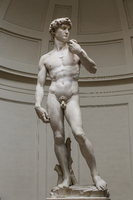 David
David Commissioned by the city of Florence, Michelangelo’s *David* serves as a strong example of the changes Europe was experiencing during the Renaissance. Instead of portraying the young shepherd David in his traditional moment of victory over the giant Goliath, Michelangelo opted to depict a concentrated David preparing for battle intently. The statue celebrates a time that a republican government ousted the Medici family from power. From 1504 to 1873, the statue stood on the main city square, before it was moved inside to the Galleria dell’Accademia for protection from weather. The brilliance of *David* lies in its craftsmanship, a testament to the “innovative style” developed in this time by “artists, especially in Italy,” who “tried to achieve a sense of balance, proportion, and harmony in their buildings, depictions of the human form, and portrayal of the natural world” (Wiesner-Hanks 153). Michelangelo also exemplifies Renaissance-era changing conceptions around the role of artists. Italian painter and architect Giorgio Vasari popularized the notion of the creative genius and dubbed “skilled and highly trained artisans” in the select “major arts” of “painting, sculpture, and architecture” (like Michelangelo) as significant individuals who “should sign and take full credit for their work” (Wiesner-Hanks 128). It is also important to note that the influx of unique new cultural products was part of a broader movement popularizing the revaluation of classical arts and texts and engendering new perspectives on political life, gender roles, and literacy.