Arts & Culture - Politics
Kings would commission political portraits in early modern Europe to act as propaganda to establish themselves to be powerful and worthy rulers of their country. These portraits sought to emphasize absolutism, a form of monarchical power that began with Louis XIV in the 17th century that asserted that rulers were given the Divine Right of Kings to rule over the people. This meant that they were unable to be restrained by institutions such as the church and lower government offices; they did however, have to obey God’s natural laws (Wiesern-Hanks, 337). These monarchies were often hereditary, meaning power was transferred generationally between family members. Therefore, monarchs wanted to emphasize the message that their family was the most holy and were the rightful holders of the Crown. In order to accomplish this, rulers would often commission painters to create propaganda images that depicted themselves as god-like figures. Louis XIV epitomized this practice by having a portrait commissioned depicting his extended family as gods. This approach showed the subjects of the kingdom that their ruler was strong and inhumanly capable; their abilities were only comparable to that of a god’s. Moreover, Louis XIV commissioned this portrait for it to be hung in his Palace of Versailles, a baroque style structure which aggrandize Louis XIV and his power. In the case of James II, his portrait was made before he was king of England, therefore asserting his ambition to be king due to his military victories. Henry IV commissioned his painting to represent his strength specifically as a king who could quell religious disputes. This style of propaganda not only encouraged the people to put their faith in their ruler, but it also justified the Divine Right of Kings. If the monarchs had powers and abilities like that of a god, then it was only natural that they be given absolute power. The choice the artists made to use classical mythologies to deify their rulers is representative of the commonplace nature of classical art and how potently symbolic its evocation was. These pieces of propaganda are key examples of kings emphasizing and embodying their god-like political power.
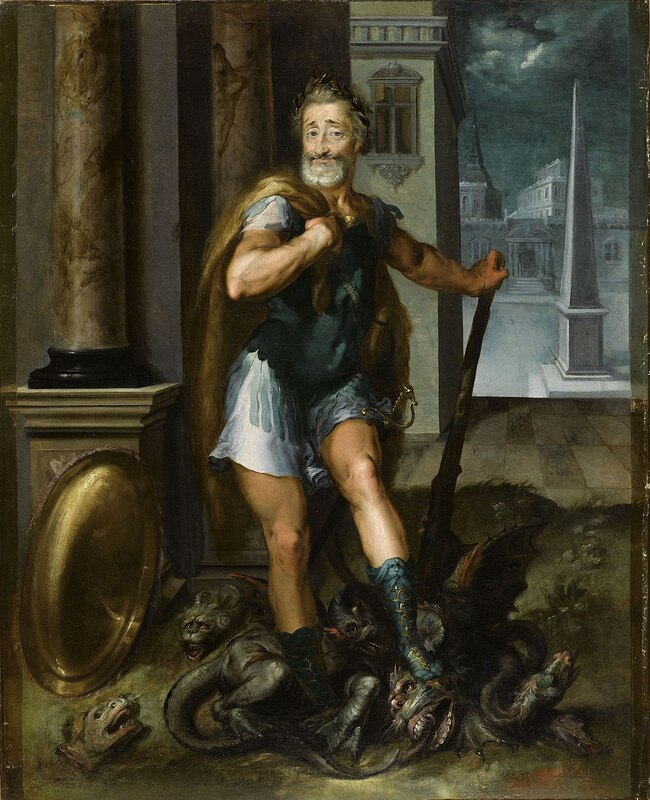
In this portrait, King Henry IV of France is depicted as Hercules slaying the Hydra, in order to emphasize his strength as a political leader and individual. Propaganda, especially artistic, was a common technique implemented by rulers to convince the people of the monarch’s competency as a ruler. Drawing on the French peoples’ previous knowledge of Hercules as a strong god, Henry IV presented himself as Hercules to suggest that he is equally as powerful. Moreover, the hydra was a mythical beast often used in this period to represent political enemies; Henry defeating this serpent reflects his settlement of the conflict of the Wars of Religion in France with the Edict of Nantes in 1598 (Collins, 24). Hercules was often depicted in ancient Greece without any heavy reinforced armor–representative of the extent of his inherent strength. Henry IV similarly depicted without armor furthers the image of him as a powerful and independent (Collins, 1).
This painting of James II, when he was the Duke of York (not yet King of England), depicts him as as Mars, the Roman god of war. The artist Henri Gascar implemented the swagger portrait style which emphasizes the social aspirations of the subject by aggrandizing their importance or status (Oxford Reference). In this case, James II is shown with an impressive fleet of ships behind him (a reference to his prowess as a military leader), and a full-bottomed wig and a walking stick (both of which are class signifiers of the time) (Royal Museums Greenwich). His costume, which consists of a Roman gladiator’s chest plate and tunic, is adorned with gold and jeweled accents. These elements not only accentuate James II grandeur, but they also depict him as the Roman god of war, Mars. This choice to present James II as a godlike figure accentuates his military abilities and the extent to which he deserves respect.
[Original author: Soren Eversoll]
Painted in 1670, this portrait of Louis XIV of France and the royal family was created by Jean Nocret to be hung in the Palace of Versailles. This work depicts Louis XIV and his family as the gods of Ancient Rome. Louis XIV’s wife is represented as Juno, the queen of the gods, the king’s brother is the god of the dawn, and among many others, Louis XIV is depicted as Apollo, the god of the sun (Versailles). Louis XIV was known as the Sun King for the way that his brilliance shone into foreign lands and how he acted as a source of energy throughout France (Louis, XIV, 145). To represent these godly powers, he began to refer to himself as the Sun King. His emblem of sun rays was prevalent throughout Versailles, and was made especially obvious in his depiction as Apollo, the Greek and Roman god of the sun.
[Original authors: Kiera Block and Chris O’Mara]