Henry IV as Hercules Slaying the Lernaean Hydra
Item
-
Title
-
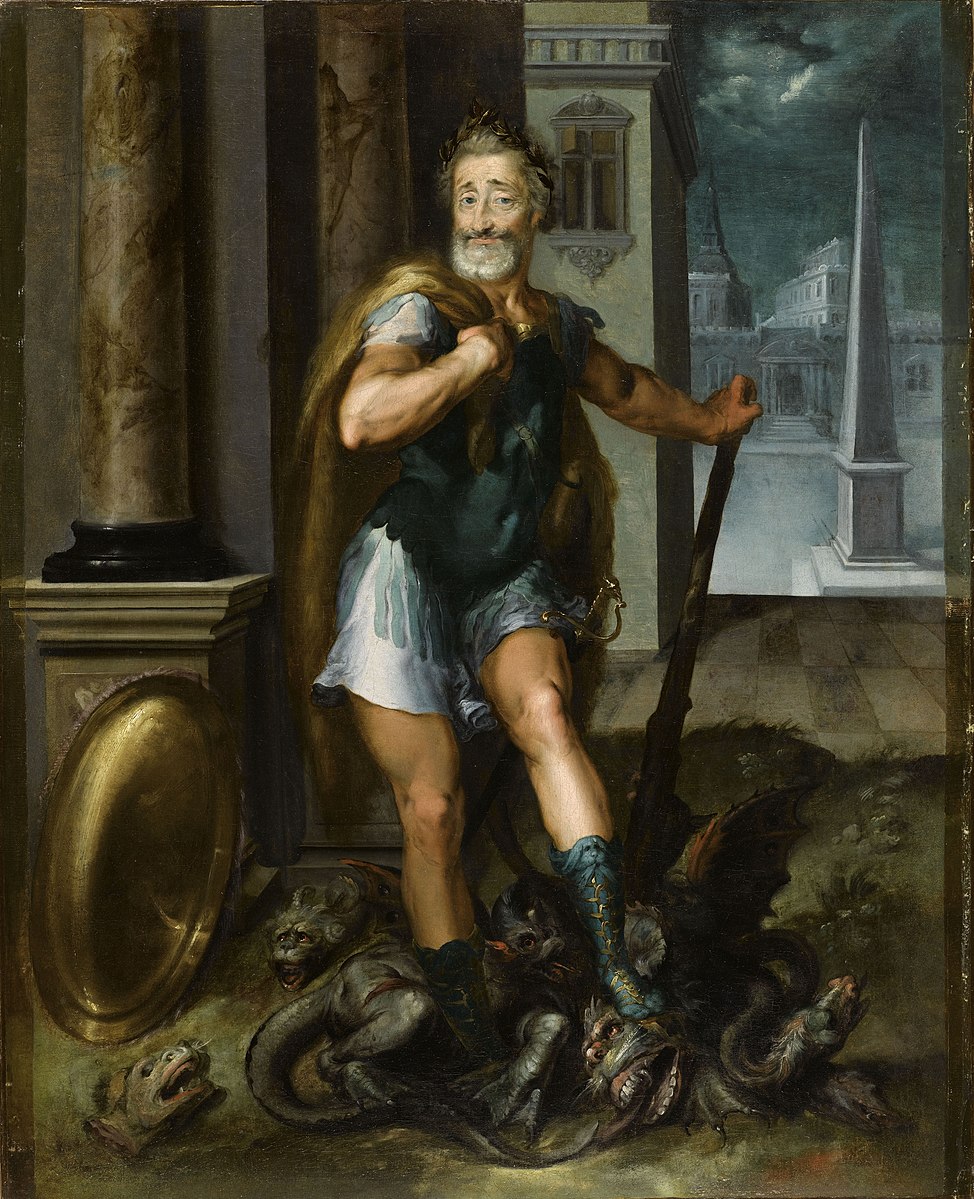
Henry IV as Hercules Slaying the Lernaean Hydra
-
Creator/author/artist of the original item
-
Circle of Toussaint Dubreuil
-
Date
-
circa 1600
-
Description
-
King Henry IV was an incredibly productive and charismatic leader in the 16th century early modern France. He was known as “Henri le Grand” for all he did to stabilize France (Collins, 24). He increased the power of the centralized government by mediating the conflicts between religious groups within the French Wars of Religion and stabilizing royal finances. Henry was born as a Protestant and was initially king as a Protestant. However, with the Catholics and Protestants already in a decades long war, Henry needed to do what he could to end the disagreement. Therefore, “he converted to Catholicism in 1593, married a devout Catholic, and successfully sought better relations with the Pope” (Collins, 24). Each of these moves was incredibly calculated as Henry did what he could to get the Catholics on his side. He also issued the Edict of Nantes which providing French Protestants with legal recognition which allowed them to continue practicing (Collins, 24). Henry also stabilized royal finances by working with the Maximilien de Béthune, the duke of Sully who repaid royal debts and provided statements of government finances (Shennan, et al.). By initiating trade between France, Spain, and England, Henry further encouraged France to prosper (Shennan, et al.).
This painting which depict Henry IV as Hercules slaying the Hydra represents Henry as both a strong political leader and individual. Henry was also known as a strong and charismatic leader, and visual propaganda was the most effective way of persuading the people of France to support Henry and his reign. The people of France all knew Hercules to be a larger-than-life figure, and to depict Henry in Herculean garb would suggest Henry to be just as powerful. The Hydra was often used in this period to represent political enemies, and so Henry defeating the beast reflects his settlement of the religious wars by defeating the Catholic Holy League (Dias Pacheco). The lack of heavy armor on Henry also reflects a common trope in visual propaganda of depicting strong figures as not needing any external protection (Collins, 1).
-
Place
-
France
-
Source Citation
-
Collins, James B. The State in Early Modern France. Cambridge, United Kingdom: Cambridge University Press, 1995.
Dias Pacheco, Milton. “Greek Mythology at the Service of the Portuguese Inquisition: The Case of Hercules and the Hydra of Lerna.” Athens Journal of Mediterranean Studies 1, no. 1 (2014).
Shennan, J.H., et al. “France in the Early 17th Century.” Britannica. Accessed February 12, 2024. https://www.britannica.com/place/France/France-in-the-early-17th-century.
-
Rights / License
-
Circle of Toussaint Dubreuil, Public domain, via Wikimedia Commons