-
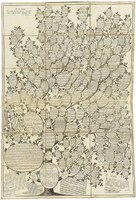 The Tree of Knowledge
 The Tree of Knowledge is a diagram of the entire system of knowledge mapped out by Diderot and d’Alembert in the Encyclopédie in the 18th century. This map was intended to visualize all of the world’s knowledge, as well as its sources and the branches that extend from them. The central trunk is labeled as “understanding” and other branches of “memory”, “reason,” and “imagination” act as the three main offshoots. Because humans cannot follow more than one mental route simultaneously, Diderot reflects this discreetness by using imagery of a tree; just as in the mind, one cannot follow more than one tree branch at a time (Lord). From the central trunk, one can see all of the potential routes that one can embark on.
The placement of the arts in relation to the rest of the tree is an interest aspect worth investigating further. The arts is the only subsection which sits emerging from the “imagination” source. This is reflective of how people of this time thought of the arts as not relating to reason or empirical thought. At least, that is how Voltaire wanted people to perceive art. In his novel, Candide, Voltaire criticizes those who critique art (Candide, 90). When discussing a play, Candide explains that he quite liked an actress in the show, while the critics who he sat next to thought she was terrible. Candide strongly believes in enjoying art for art’s sake, and not trying to rationalize artistic decisions with reason or memory. Candide emphasizes the importance of not overanalyzing what is beautiful to the point of nonsense.
-
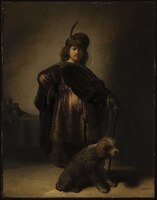 Self-Portrait in Oriental Costume
 Baroque art emerged in Rome during the late sixteenth century in response to the orderly and predictable art of the Renaissance. This artistic movement is characterized by theatrical and oversaturated subjects and scenes intended to invoke emotional reflection and introspection within the viewers (Wiesner-Hanks, 414). It accomplished this partially by the stark light and shadows throughout the paintings. Caravaggio was the first to implement such a such a strong singular light source with deep shadows, but baroque painters after him, such as Rembrandt, followed in his wake (Wiesner-Hanks, 414). Baroque was also intended to be a celebration of leaders and their power, whether it be religious or secular. Louis XIV’s Versailles, for example, is in the baroque style and overtly acts as a piece of propaganda for the king and his sovereign power.
Rembrandt, a baroque artist lived and worked out of the Netherlands in the sixteenth century. He is considered one of the Dutch masters of the time, others of whom were Franz Hals and Jan Vermeer (Wiesner-Hanks, 416). Each of these artists perfected a subject matter whether it be landscape, or as it was for Rembrandt, portraiture. Having painted about 100 self-portraits, he depicted “individual personalities often engaged in introspection” (Wiesner-Hanks, 416). These painting were not made for specific wealthy patrons, but instead were made to be sold at art fairs and markets which became popular gathering places for people who wanted to be involved with the arts and culture of the time.
In Rembrandt’s Self-Portrait in Oriental Costume, he depicts himself standing in a darkly lit space with eastern-style clothes and a turban. This reference to eastern culture is due to the vast trade network the Dutch had with Asia, and the large supply of Asian goods in the Netherlands during the 16th century (Wiesner-Hanks, 525). The primary export from Asia was spices, there were so many spices imported into the Dutch ports that prices depressed and profit decreased. In order to regulate this, they created the Dutch East India Company which acquired a national monopoly on spices and trade in the 17th century. The Dutch presence in trade within the Indian Ocean decreased after some time, due to their inability to expand beyond spice trade and to deal with political developments (such as the massacre of Chinese laborers) (Wiesner-Hanks, 528). However, when Rembrandt made this self-portrait, Dutch trade with Asian countries was at its peak as a prominent component of everyday life.
-
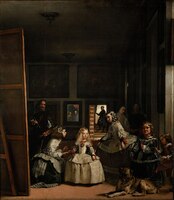 Las Meninas
 Diego Velázquez’s painted Las Meninas in 1656 for the king of Spain. This was during the Habsburg Empire which was when Spain was at the peak of its political and economic power. However, in the latter half of the 17th century, Spain and its economy began to decline throughout the country due to the decrease in silver and silver tax revenue which came from New Spain and the importation of silver (Elliot, 173). The production of art and culture follows this trend as more works were produced when Spain was succeeding, while less were produced as the country struggled (Stewart).
Velázquez was the court painter to King Phillip IV and was very concerned with his own ranking within society. Regarding his painting style, he was inspired by Caravaggio from Italy and his striking lighting and dramatic colors (Wiesner-Hanks, 416). It was this talent as well as his ability to use impressionist brushstrokes, a technique never seen before, that caught the eye of Phillip IV. He became the main painter for the Habsburg royal family and worked with them for over thirty years. The long-term commitment that both parties had to the relationship between Velázquez and the Habsburg family proves how important reliable relationships were to the people of this time. In in order to maintain an Empire throughout centuries, it needed to be built off of strong relationships, even within less people such as the court painter.
Las Meninas is considered a masterpiece among art historians, but it has troubled them for centuries as they try to decipher what Velázquez intended. What appears to be the main subject of the painting is the Spanish princess as she is being tended to by her ladies-in-waiting. However, when looking at the left of the scene one can see Velázquez himself working at a large canvas; the mirror behind him reflects the true focus of the painting, King Phillip IV and his queen (Stewart). This painting was hung in Phillip IV’s office, and so it is hypothesized the Velázquez painted the scene as he did so Phillip IV could always be gazing people most important to him, as he did when he was posing for the portrait (Stewart). By including himself in this painting, Velázquez is securing his position as an important figure in the Habsburg family, ensuring that even when Spain had a drastic economic decline he would still be secure.
-
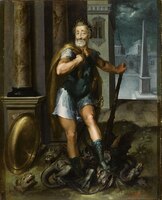 Henry IV as Hercules Slaying the Lernaean Hydra
 King Henry IV was an incredibly productive and charismatic leader in the 16th century early modern France. He was known as “Henri le Grand” for all he did to stabilize France (Collins, 24). He increased the power of the centralized government by mediating the conflicts between religious groups within the French Wars of Religion and stabilizing royal finances. Henry was born as a Protestant and was initially king as a Protestant. However, with the Catholics and Protestants already in a decades long war, Henry needed to do what he could to end the disagreement. Therefore, “he converted to Catholicism in 1593, married a devout Catholic, and successfully sought better relations with the Pope” (Collins, 24). Each of these moves was incredibly calculated as Henry did what he could to get the Catholics on his side. He also issued the Edict of Nantes which providing French Protestants with legal recognition which allowed them to continue practicing (Collins, 24). Henry also stabilized royal finances by working with the Maximilien de Béthune, the duke of Sully who repaid royal debts and provided statements of government finances (Shennan, et al.). By initiating trade between France, Spain, and England, Henry further encouraged France to prosper (Shennan, et al.).
This painting which depict Henry IV as Hercules slaying the Hydra represents Henry as both a strong political leader and individual. Henry was also known as a strong and charismatic leader, and visual propaganda was the most effective way of persuading the people of France to support Henry and his reign. The people of France all knew Hercules to be a larger-than-life figure, and to depict Henry in Herculean garb would suggest Henry to be just as powerful. The Hydra was often used in this period to represent political enemies, and so Henry defeating the beast reflects his settlement of the religious wars by defeating the Catholic Holy League (Dias Pacheco). The lack of heavy armor on Henry also reflects a common trope in visual propaganda of depicting strong figures as not needing any external protection (Collins, 1).
-
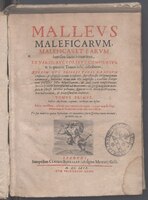 Malleus Maleficarum
 The practice of witch hunting was prominent throughout the 15th century, and by using the texts that were published during the time we are able to formulate a full understanding of this phenomenon. The Malleus Malleficarum is a text written in 1486 by a German Dominican Friar, Heinrich Kramer. He was authorized by the pope to hunt witches in southern Germany, and he did so with a heavy hand. After the time he spent torturing and executing women, he wrote Malleus Malleficarum, or, The Witches’ Hammer, commanding his audience to be wary of women and their propensity for witchcraft. According to Kramer, “all witchcraft comes from carnal lust, which in women is insatiable” (Wiesner-Hanks, 455). The thesis of Kramer’s Malleus Malleficarum claims that women alone have qualities that turn them to work with the devil. The misogyny throughout the witch hunt is especially prevalent in the search for a “witch’s mark” (Wiesner-Hanks, 460). Men would strip and shave the women, searching for a mark that proved that they had been touched by the devil. This clearly shows the practice of sexual assault that was common during these hunts, and how women were stripped of their agency and taken advantage of. Kramer explains other methods of torturing the accused witches such as “swimming” them. This practice involved throwing the woman into a body of water and watching to see if she sinks or floats, sinking (and drowning) meant she was innocent, while floating (and surviving, only to be executed later) meant she was a witch. (Wiesner-Hanks 459). Kramer’s publication was so influential not only because of the evocative messages throughout the book, but also because with the invention of the printing press, many people throughout Europe were able to read his guide to identifying and stopping witches. This quick spread of information led to a kind of mass hysteria and genuine fear of and belief in witches.
-
 Gunpowder
 Gunpowder was a key item in Europe beginning in the 13th century, though it was first invented in China in the 12th century and did not reach the west until the Mongols spread gunpowder technology into Europe. The influence of gunpowder it became especially prevalent in the 14th century with the rise of Niccolò Machiavelli and his value in role of war in a nation’s success. In Machiavelli’s words, “when princes think more of luxury than or arms, they lose their state” (Wiesner-Hanks, 95). Machiavelli believed that nobles, instead of concerning themselves with frivolous aspects of a wealthy life, needed to focus their efforts on broadening their political influence in order to encourage a prosperous state.
As wars raged throughout the 14th and 15th centuries in Europe, armies began to use gunpowder technology to increase their success on the battlefield. Initially, the cavalry, a group of soldiers on horseback with swords, was the primary force used in battles. These soldiers were typically nobles who would participate in battles as propaganda to encourage their people to support them (Wiesner-Hanks, 99). They were able to ‘fight’ in battle, while still literally sitting above the other soldiers. Now with the common foot soldiers wielding firearms, the nobles atop horses were less notable. To compensate for this, nobles were given pistols, a short-barreled firearm that allowed them to shoot from a very close range, reestablishing the social hierarchy within the army (Wiesner-Hanks, 99). While firearms and gunpowder made battles much more efficient, even beginning what some have called a “military revolution”, it was very expensive technology (Wiesner-Hanks, 101). Only kings, sultans, and emperors could afford to outfit their entire armies, nobles and other people in power did not have nearly enough funds to provide firearms for armies of thousands of people. Gunpowder is one of the most impactful technologies of military advancement, one that Machiavelli would be in full support of.
-
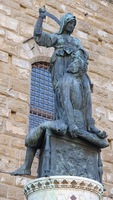 Judith and Holofernes
 Sculptors of the Renaissance around the 14th century were heavily influenced by the artists of ancient Greece and Rome, and often looked to them for inspiration as they carved their own works. While these ancient sculptures were created in workshops with many artists and apprentices working together, the Renaissance sculptor Donatello worked alone (Vasari, 189). He lived in the 14th and 15th centuries in Florence, Italy and was passionate about reinvigorating the beautiful traditions of ancient Greek sculptures. He reflected this in his sculptures through “spatial depth, dramatic scenes, classical themes and settings, expressions of weight and force” (Wiesner-Hanks, 160). He was especially concerned with depicting the natural world through idealizations. Artists of this time believed that the purest forms were found in nature, though they also acknowledged nature's visual imperfections. To compensate for this, artists would create an illusion of the natural world, disregarding its flaws (Wiesner-Hanks, 160). Donatello built upon the techniques of the ancients, breathed life into his sculptures, and idealized the natural form particularly in his sculpture of the Bible story of Judith and Holofernes. In 1455 the Signoria of Florence commissioned Donatello to make this bronze sculpture for it to be displayed in the piazza (Vasari, 179). The close relationship of religion and politics and the emphasis on Christian reformation resulted in a lot of religiously inspired art, especially when the art was commissioned by the government. This sculpture depicts Judith of Bethulia which was besieged by General Holofernes and the Assyrians. Donatello portrays the moment in which Judith decides to free her city by killing Holofernes. This sculpture expertly depicts the strength from God found within Judith as she stands up tall with her eyes gazing forward, frozen in the moment after she has brought down her sword on Holofernes’ neck. This feminine power is clearly contrasted with Holofernes’ limp body and closed eyes as he is overcome with death (Vasari, 179). Even in this moment of weakness however, Donatello depicts Holofernes with a sense of elegance, recalling the tendency of Renaissance artists to idealize their subjects.