-
Title
-
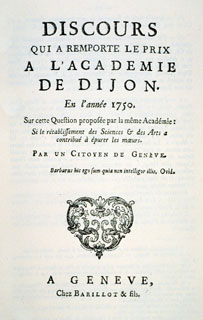
Discourse on the Arts and Sciences
-
Creator/author/artist of the original item
-
Jean-Jacques Rousseau
-
Date
-
1750
-
Description
-
A massively controversial debut, Jean-Jacques Rousseau’s “Discourse on the Arts and Sciences” burst onto the scene in 1750, winning an essay contest sponsored by the Academy of Dijon on “whether the restoration of the Sciences and the Arts has contributed to the purification of morals.” This prompt illustrates a common Enlightenment narrative. The “restoration of the Sciences and the Arts” speaks to Renaissance humanism and the rediscovery of classical texts, which was commonly framed in this period as a sharp break from the prior “dark ages,” bringing about technological, scientific, and cultural innovations. However, Rousseau’s discourse took a strong, unpopular stance against the moral benefits of the popularization of the arts and sciences. Moreover, this essay serves to exemplify the stage for intellectual disagreement that became prominent in the Enlightenment. Along with furious debate and investigation among intellectuals, this period saw the rise of the public sphere, where citizens gradually became increasingly invested in politics, philosophy, science, and more. Rousseau argues that modernity has forced people to live insincerely, engendering a smallness of soul within them. Examining modern society, Rousseau explicates how citizens see themselves as rational pursuers of self-interest (beginning with Machiavelli’s break from the high-minded and abstract “virtue” of classical political philosophy). Figures like Locke and Hobbes, writing after one of the deadliest periods of religious strife in European history, sought to ground society in self-interest and create institutions that could guide a rational citizenry to minimize violence and incentivize the “common good.” In stark contrast, Rousseau vividly paints a dispiriting portrait of a society where the thing one wants the most is to swindle their neighbor, for there is no legitimate profit that cannot be outdone by an illegitimate profit. The only thing preventing one from conquering their peers is the law, the institutions that citizens begrudgingly agree to follow out of fear. Even though the restoration of the arts and sciences has brought about great discoveries about the orbits of the heavenly bodies, Rousseau asks if mankind is better governed or more virtuous because of this. Interestingly, Rousseau does not argue entirely against the arts and sciences, but rather against their popularization. Near the end of his discourse, he describes how brilliant minds like Bacon, Newton and Descartes, “Preceptors of Mankind,” should pursue the sciences and the arts, but should not share their findings with the public (Rousseau 59). It is in the dissemination of their findings and the visible rewards and praises of these figures, that Rousseau observes corruption. These are the sources of the dogmatic embrace of skepticism and reason that Rousseau finds in so many “pseudo-intellectuals” and sophists who parade around undermining the foundations of morality like religion and love of the fatherland (grounded in customs and beliefs, not reasoning). Whatever a society rewards, it inherently encourages, and Rousseau sees himself surrounded by people who are widely honored and massively wealthy thanks to their talents as writers, artists, etc., regardless of the quality of their character. This encourages people to pursue money and glory rather than virtue. Ultimately, Rousseau’s “Discourse on the Arts and Sciences” set the foundation for his political project, the legacy of which is deeply complex and played a major part in political revolutions (especially the French Revolution). Much like Rousseau, the Enlightenment shares a complicated legacy. While many movements of the nineteenth, twentieth, and twenty-first century used Enlightenment concepts in their efforts to expand the rights of different groups, it is critical to note that “The Enlightenment has been seen as both a liberating movement that resulted in the revolutions of the later eighteenth century, and an authoritarian movement that justified racism and European imperial domination” (Wiesner-Hanks 389).
-
Place
-
Geneva, Switzerland
-
Source Citation
-
Rousseau, Jean-Jacques. “Discourse on the Arts and Sciences”, Paris, Academy of Dijon, 1750
-
Wiesner-Hanks, Merry E. *Early Modern Europe, 1450-1789*. 3rd ed. of *Cambridge History of Europe*. Cambridge: Cambridge University Press, 2022.
-
Rights / License
-
Public Domain