-
Title
-
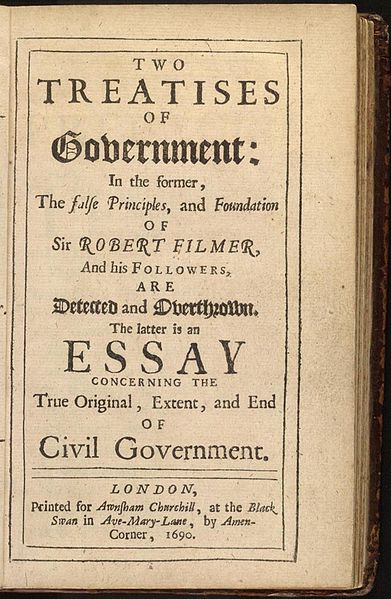
Two Treatises of Government
-
Creator/author/artist of the original item
-
John Locke
-
Date
-
1689
-
Description
-
John Locke’s *Two Treatises of Government* was a major work of political philosophy that refuted the theory of the divine right of kings and set the stage for the emergence of the middle class. Locke’s writings, however, can only be properly understood in the context of 17th century European politics. After the death of Queen Elizabeth I in 1603, her cousin James I succeeded her. Lacking the tactical adeptness of his predecessor, James’ tenure was marked by struggles with Parliament about spending, marriages, and religion. By the time Charles I took over in 1625, the country was increasingly divided and his leadership only worsened matters. Eventually, tensions between Parliament and the Crown boiled over into civil war and Charles I was executed in 1649. Until 1660, England was in a period of Interregnum, in which they attempted various forms of republican government. However, when Oliver Cromwell passed away, his son Richard succeeded him as Lord Protector and did not have the power base between Parliament and the military to lead. Thus, the crown was restored with the son of Charles I, Charles II. But when Charles II died in 1685, the throne fell to his brother James II. Since James II was Catholic, the English were very opposed to his succession, resulting in the Glorious Revolution of 1688, which deposed James II and installed the Protestant William III and Mary II, confirming the primacy of Parliament over the Crown. Beyond just defending the Glorious Revolution, Locke’s writings established a new understanding of the purpose of government. Perhaps even more importantly, Locke’s project of political philosophy helped change individual citizens’ understanding of their relationship to their rulers. Drawing on the authority of God and examining the conditions of humans living in their ‘natural state’ before entering into societies and forming governments, Locke asserts that all people have property (including both the things one possesses as well as one’s “life, liberty, and estate, which he describes, somewhat vaguely, as ‘natural rights’ given to humans by God”) that they are naturally inclined to protect and improve (Wiesner-Hanks 383). For Locke, one can attain a natural right to an object of nature when they mix their labor with it (e.g. when a person cultivates a field, they have earned the right to that property and the fruits of its harvest). Since God commanded men to cultivate the earth, people should ‘improve’ the Earth by being industrious and rational, pursuing the expansion of their property and increasing the productivity of the Earth. Society, therefore, is an agreement among individuals in the state of nature who decide to sacrifice some of their natural freedoms in order to pursue the expansion of one’s property with a general network of protection and recourse in the event of disagreements, which all too easily become wars in the state of nature where nothing prevents one person from conquering another. This is a starkly distinct understanding of one’s purpose in life that minimizes the influence of the religious sects, “noble aristocrats,” and monarchs responsible for many of the problems of Locke’s times. Instead, after the brutal religious strife that decimated Europe in the 17th century, Locke is valorizing work, reason, and personal happiness, arguing that the purpose of government is to increase population and encourage industrious behavior.
-
Place
-
Essex, England
-
Source Citation
-
Wiesner-Hanks, Merry E. *Early Modern Europe, 1450-1789*. 3rd ed. of *Cambridge History of Europe*. Cambridge: Cambridge University Press, 2022.
-
Locke, John. *Two Treatises of Government*, Essex, England, Awnsham Churchill, 1689
-
Rights / License
-
Public Domain