Las Meninas
Item
-
Title
-
Las Meninas
-
Creator/author/artist of the original item
-
Diego Velázquez
-
Date
-
1656
-
Description
-
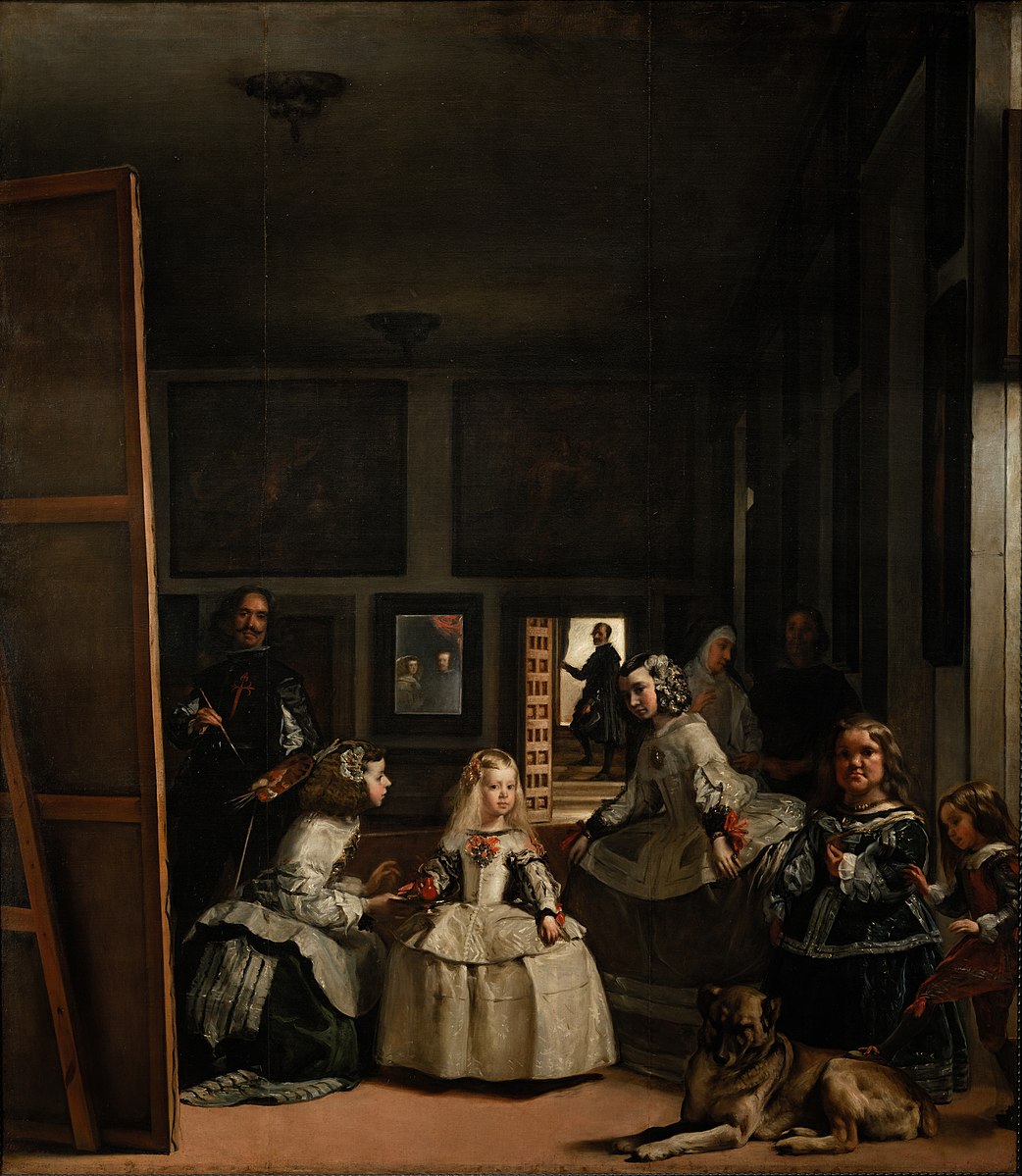
Diego Velázquez’s painted Las Meninas in 1656 for the king of Spain. This was during the Habsburg Empire which was when Spain was at the peak of its political and economic power. However, in the latter half of the 17th century, Spain and its economy began to decline throughout the country due to the decrease in silver and silver tax revenue which came from New Spain and the importation of silver (Elliot, 173). The production of art and culture follows this trend as more works were produced when Spain was succeeding, while less were produced as the country struggled (Stewart).
Velázquez was the court painter to King Phillip IV and was very concerned with his own ranking within society. Regarding his painting style, he was inspired by Caravaggio from Italy and his striking lighting and dramatic colors (Wiesner-Hanks, 416). It was this talent as well as his ability to use impressionist brushstrokes, a technique never seen before, that caught the eye of Phillip IV. He became the main painter for the Habsburg royal family and worked with them for over thirty years. The long-term commitment that both parties had to the relationship between Velázquez and the Habsburg family proves how important reliable relationships were to the people of this time. In in order to maintain an Empire throughout centuries, it needed to be built off of strong relationships, even within less people such as the court painter.
Las Meninas is considered a masterpiece among art historians, but it has troubled them for centuries as they try to decipher what Velázquez intended. What appears to be the main subject of the painting is the Spanish princess as she is being tended to by her ladies-in-waiting. However, when looking at the left of the scene one can see Velázquez himself working at a large canvas; the mirror behind him reflects the true focus of the painting, King Phillip IV and his queen (Stewart). This painting was hung in Phillip IV’s office, and so it is hypothesized the Velázquez painted the scene as he did so Phillip IV could always be gazing people most important to him, as he did when he was posing for the portrait (Stewart). By including himself in this painting, Velázquez is securing his position as an important figure in the Habsburg family, ensuring that even when Spain had a drastic economic decline he would still be secure.
-
Place
-
Spain
-
Source Citation
-
Elliot, J.H. “The Decline of Spain.” In The Economic Decline of Empires. London, 1970.
Stewart, Jessica. “The History and Mystery of ‘Las Meninas’ by Diego Velázquez.” My Modern Met, February 28, 2022. https://mymodernmet.com/diego-velazquez-las-meninas/.
Wiesner-Hanks, Merry E. “Early Modern Europe, 1450–1789.” 3rd ed. Cambridge History of Europe. Cambridge: Cambridge University Press, 2022. doi:10.1017/9781009160797.
-
Rights / License
-
Diego Velázquez, Public domain, via Wikimedia Commons