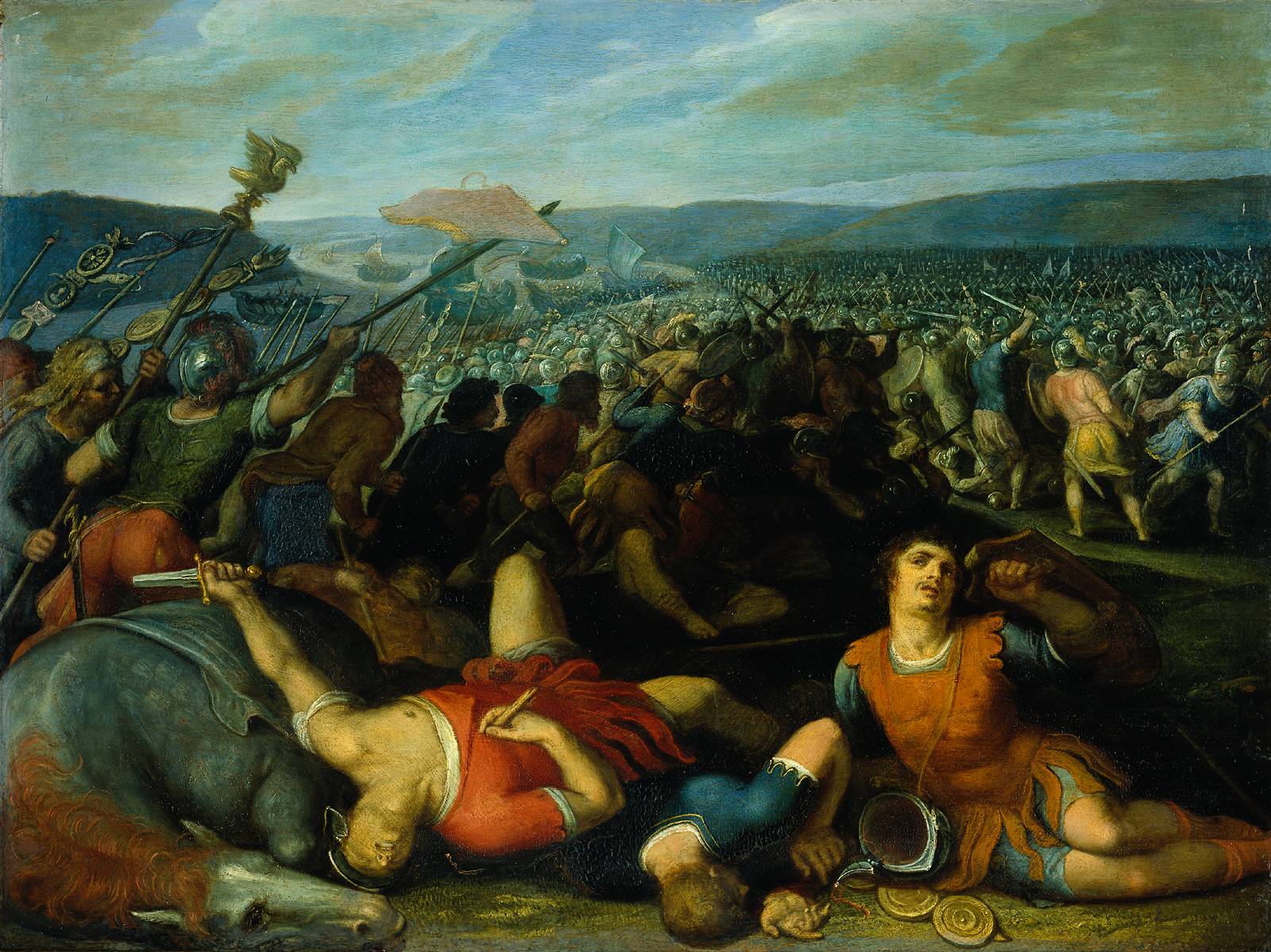
Batavians Defeating Romans on the Rhine
Item
-
Title
-
Batavians Defeating Romans on the Rhine
-
Creator/author/artist of the original item
-
Otto van Veen
-
Date
-
c. 1613
-
Description
-
*Batavians Defeating Romans on the Rhine* is a painting by Otto van Veen, made around the year 1613. It was commissioned by the States General of the Dutch Republic. It depicts a moment in the ancient history of the Netherlands, during the revolt of the Batavi against the Roman Empire from 69-70 AD. The Batavi were a tribe inhabiting the Roman province of Germania Inferior, which consisted of much of modern-day Belgium and the Southern Netherlands. Led by Gaius Julius Civilis, Batavian auxiliaries turned on the Roman Empire and seized many fortresses and much of the Roman Rhine flotilla, then defeated two legions in a battle.
In the foreground of the painting, three figures and a horse are sprawled, in various states of death or dying. On the left there are several charging soldiers, holding aloft an assortment of standards. One of these standards is an eagle, indicating that these soldiers are Roman. They are charging forward towards the background of the painting, where large masses of soldiers are having a battle on the banks of a river. The river, in the left of the background, contains a number of ships.
In the context of 1613, this painting and the conflict between the Batavi and Rome can be seen as a stand-in for the Eighty Years War and the conflict between the fledgling Dutch Republic and the Habsburg Spanish Empire. In the 16th and 17th centuries, the Batavians were increasingly being considered to be the ancestors of the Dutch. The image of these ancestral figures heroically rebelling against the foreign occupation of the Roman Empire, parallels the Dutch rebellion against their occupation by the Spanish Empire. The parallel is especially strong given that the Austrian Habsburg line, as leaders of the Holy Roman Empire, still held the title Imperator Romanorum.
In their declaration of independence, the Dutch States General argued that their reason was “for maintaining the rights, privileges, and liberties of our countrymen,” and “to secure our ancient liberties and privileges” (pp. 10). The keywords ‘countrymen’ and ‘ancient’ point towards an increasing development of a Dutch national identity. The development of a national identity often relies heavily on an appeal to an imagined ancient community – here, we see the Dutch identifying the Batavi as ancient predecessors of their own nation. When the Dutch East India Company captured Jakarta in 1619, they renamed it Batavia (Weisner Hanks 500) – this renaming shows that the idea of a Batavian origin was strong in the Dutch consciousness during this time period. The Dutch States General, by commissioning this work, contributed to a growing national identity and characterized the ongoing Dutch Revolt as a continuation of 1500 years of national struggle towards independence.
-
Place
-
Netherlands
-
Source Citation
-
Van Veen, Otto. *Batavians Defeating Romans on the Rhine*, c. 1613. Oil on panel, 38 cm x 52 cm. Netherlands, Rijksmuseum.
-
Rights / License
-
Public domain, via Wikimedia Commons