-
 Batavians Defeating Romans on the Rhine
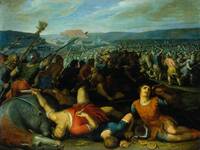
 *Batavians Defeating Romans on the Rhine* is a painting by Otto van Veen, made around the year 1613. It was commissioned by the States General of the Dutch Republic. It depicts a moment in the ancient history of the Netherlands, during the revolt of the Batavi against the Roman Empire from 69-70 AD. The Batavi were a tribe inhabiting the Roman province of Germania Inferior, which consisted of much of modern-day Belgium and the Southern Netherlands. Led by Gaius Julius Civilis, Batavian auxiliaries turned on the Roman Empire and seized many fortresses and much of the Roman Rhine flotilla, then defeated two legions in a battle.
In the foreground of the painting, three figures and a horse are sprawled, in various states of death or dying. On the left there are several charging soldiers, holding aloft an assortment of standards. One of these standards is an eagle, indicating that these soldiers are Roman. They are charging forward towards the background of the painting, where large masses of soldiers are having a battle on the banks of a river. The river, in the left of the background, contains a number of ships.
In the context of 1613, this painting and the conflict between the Batavi and Rome can be seen as a stand-in for the Eighty Years War and the conflict between the fledgling Dutch Republic and the Habsburg Spanish Empire. In the 16th and 17th centuries, the Batavians were increasingly being considered to be the ancestors of the Dutch. The image of these ancestral figures heroically rebelling against the foreign occupation of the Roman Empire, parallels the Dutch rebellion against their occupation by the Spanish Empire. The parallel is especially strong given that the Austrian Habsburg line, as leaders of the Holy Roman Empire, still held the title Imperator Romanorum.
In their declaration of independence, the Dutch States General argued that their reason was “for maintaining the rights, privileges, and liberties of our countrymen,” and “to secure our ancient liberties and privileges” (pp. 10). The keywords ‘countrymen’ and ‘ancient’ point towards an increasing development of a Dutch national identity. The development of a national identity often relies heavily on an appeal to an imagined ancient community – here, we see the Dutch identifying the Batavi as ancient predecessors of their own nation. When the Dutch East India Company captured Jakarta in 1619, they renamed it Batavia (Weisner Hanks 500) – this renaming shows that the idea of a Batavian origin was strong in the Dutch consciousness during this time period. The Dutch States General, by commissioning this work, contributed to a growing national identity and characterized the ongoing Dutch Revolt as a continuation of 1500 years of national struggle towards independence.
-
 Shah Jahan, Standing with a Flower and a Sword
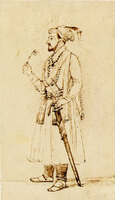
 *Shah Jahan, Standing with a Flower and a Sword* is an ink drawing on paper by the Dutch artist Rembrandt van Rijn. This drawing shows Shah Jahan, the Mughal emperor who reigned from 1628-1658 and the commissioner of the Taj Mahal. Jahan is dressed in a robe, scarves, several necklaces, and a feathered and bejeweled headwrap. He has one hand resting on the hilt of a sword strapped to his waist. In his other hand he carries a flower, which he is looking at. Jahan’s head is surrounded by a halo and is sending light in every direction.
This work is one of more than twenty drawings made by Rembrandt which were based on Mughal miniatures. Wiesner-Hanks says that Dutch artists, but especially Rembrandt “showed deep insight in their work, capturing individual personalities often engaged in introspection” (396). In this drawing, although it is not one of Rembrandt’s standard portraits, I do think that there is a depiction of introspection through Jahan’s consideration of the flower.
This drawing is particularly interesting in how it relates to the Netherlands’ position in the world in the 1650s. The Dutch East India Company had been established in 1602 and begun to build and seize fortified trading posts in the vicinity of the Indian Ocean. In 1619, they had captured Jakarta, and by the time of this painting had seized many of Portugal’s outposts in the Indian Ocean (Wiesner-Hanks 500-501). The Dutch East India Company in this time period had been granted the right to trade in many of the Mughal Empire’s port cities, and through this relationship goods were flowing back and forth between the Mughal Empire and the Netherlands.
Although we do not know exactly from whom Rembrandt acquired the figures he based this drawing off of, his possession of Mughal artwork is indicative of the increased exchange of both material goods and ideas between India and Europe in the 17th century. He also did all of this series of drawings on paper imported from Asia, again showing the flow of material goods. Although Rembrandt is most famous for other works, this drawing is particularly illustrative of the way that colonialism affected the world of art. Rembrandt here is imitating and learning from the Mughal style of art, and fusing his own tradition of art with a tradition from an area of the world that his country was colonizing. This drawing is a good reminder of the way that colonial relationships brought about cultural exchange.
-
 Glorification of Commerce and Science
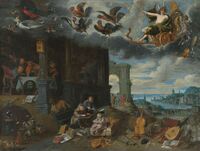
 *Glorification of Commerce and Science*, also called *The Children of the Planet Mercury*, is an oil painting by Jan Bruegel the Younger, the grandson of Pieter Bruegel. In this painting, we have educated individuals studying and conducting science in the left and bottom, while in the background there is a harbor where other citizens watch plays and race horses. Above it all, the god Mercury is riding in a chariot pulled by various birds. Various instruments, sporting equipment, and games are being poured out of his chariot by a monkey.
Thematically, I think that this painting is contrasting diligence and diversion. We have scientists and children studying in the foreground, while in the background crowds of people are dancing and watching a play. In the bottom left corner we have monkeys doing alchemy, while in the bottom right we have monkeys playing dice, and the monkey in Mercury’s chariot is pouring means of diversion, like instruments and decks of cards, into the world.
This painting connects with our class material in that it shows a fascination with scientific instruments, the character of the scientist, alchemy, and the education of children. On the left side of the painting we can see a group of scientists huddled around a table, with an astrolabe and a globe nearby and papers on geometry and the building of fortifications in the foreground. Beneath these scientists, in the bottom left corner, we see three monkeys working an alchemical furnace in order to distill a brown liquid. At the bottom of the painting there are three children studying. On the ground nearby are several books in various disciplines. The books cover topics such theology, poetry by Virgil, medicine by Galent. This mixing of theological, classical, and scientific texts is a good reminder of Wiesner-Hanks’ point that the Scientific Revolution should not be characterized as a battle between religion and science (378). This is not to say that the relationship between science and religion was not something people in the period were considering. In the painting, there is a book marked ‘D. Faust’ among the children’s books. Faust was a legendary figure whose desire for knowledge led him to make a pact with the devil. It is hard to say what Bruegel meant by the inclusion of this book, but I might speculate that the legend of Faust showed an anxiety in society about the relationship between educated individuals, science, and religion. Societal preoccupation with figures like Faust helps explain some of the hostility that Galileo describes in his *Letter to the Grand Duchess*.
-
 Landscape with the Fall of Icarus
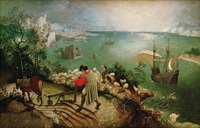
 *Landscape with the Fall of Icarus* is a painting in oil on canvas painted either by Pieter Bruegel or an unknown artist copying Bruegel's original. The painting depicts the aftermath of the story of Icarus. In Greek mythology, Icarus is the son of the inventor Daedalus. He escapes imprisonment using wings made by his father, but in the process flies too close to the sun. This causes the wax holding his wings together to melt and him to plummet into the ocean and die.
What is interesting about this painting is that it does not center on Icarus - he can only be seen as a pair of legs floundering in the ocean on the bottom right. A nearby fisherman pays his drowning no attention, and the central figure is a peasant in the foreground, who is looking towards the ground. This peasant seems totally occupied with his work and ambivalent towards the drowning of Icarus. One might speculate that the theme is man's ambivalence towards the suffering of others. Such a theme would not be out of place in the 16th century Low Countries. Although the Eighty Years War would not start in Bruegel's lifetime, the Reformation had already hit the Netherlands. With sizable communities of Calvinists and Anabaptists developing, religious persecution was on the rise.
Throughout his career, Bruegel took peasants as his primary subject matter. This concern with peasant lifestyle and the peasant mind is interesting in that it follows not long after the German Peasants War. WIth the advent of the printing press, the concerns which troubled peasants could be written down and widely distributed. We see this in the Twelve Articles of the Peasants of Upper Swabia, in which peasants list their issues with their economic and political arrangements and give religious arguments against these arrangements (Baylor 76-82). These peasants were not 'keeping their eyes on the ground'. This is not to say that Bruegel had any political interpretation in mind. It is only to say that at the time, what sorts of things peasants should concern themselves with was an open and debated political question.
-
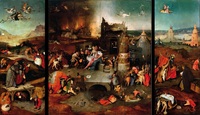 Triptych of the Temptation of St. Anthony
 This piece is a triptych, a work consisting of three connected panels, made from oil on oak. It was made by Hieronymus Bosch, a Dutch artist of the Northern Renaissance.
The painting shows three scenes, each from the life of Saint Anthony. Saint Anthony was an early Christian figure, a man who left his worldly life in favor of a more spiritual life of isolation in the desert. According to legend, this movement into the desert led Saint Anthony to be harassed by hordes of demons.
This painting shows a concern with the abundant evil of the world, something that preoccupied the thoughts of northern 'Christian humanists'. For instance, in "The Praise of Folly" Erasmus notes the danger posed by "wicked prelates" (Wiesner-Hanks 142). In the left panel, Bosch draws a demon with the head of a stag, garbed in the robes of a priest. In the center panel, very near the praying figure of St. Anthony, we can also see a demon disguised as nun, and below this a rat-faced demon with the tonsured haircut of a monk reads from a book. These characterizations of religious figures as sinners or demons in disguise give us a window into the perspectives some people at the time had about religious figures, which contextualizes the emphasis on church reform of many Northern humanists.
The world Bosch depicts in this painting is one of ubiquitous evil, one where evil abounds in forms both open and disguised. This assumption is echoed by Vives in his “The Education of a Christian Woman”, when he argues that humans need “knowledge of good to protect us from the constant onslaught of evil” (63). In different ways, Bosch and Vives both depict authentic religiosity as creating an island of good within a world which is a sea of evils.