The Emancipation Statue ('Bussa')
Item
-
Title
-
The Emancipation Statue ('Bussa')
-
Creator/author/artist of the original item
-
Karl Broodhagen
-
Date
-
1985
-
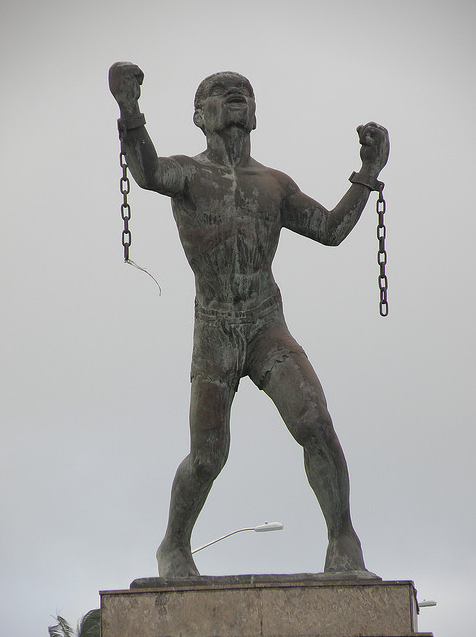
Description
-
*The Emancipation Statue* is a public sculpture in Barbados that depicts the leader of a slave rebellion in 1816 valiantly breaking his chains in an expression of his humanity. Created in 1985 by Bajan sculptor Karl Broodhagen, the bronze statue is often called ‘*Bussa*,’ the name of an enslaved person who actually helped inspire the 1816 revolt. This statue highlights the impact of slavery on the history of Barbados, one of many places in the ‘New World’ that would be dramatically altered by the “European voyages, trading ventures, and colonization” of the 16th and 17th centuries (Wiesner-Hanks 291). Between 1625 and 1807, about 2.7 million enslaved Africans were brought to the British Caribbean. More than 500,000 enslaved Africans were brought to Barbados alone, an island of just 166 square miles. By 1680, Barbados was the richest, most populous, and most highly developed colony in British America and by the late 1770s, the average white person in the British West Indies was making over ten times as much money as the average white person in other parts of the British Empire, including England (Brueckmann 2024). Beyond Barbados though, Europe’s colonization of the ‘New World’ also “encouraged warfare, siphoned off productive workers, and destroyed kinship groups” on the west coast of Africa (Wiesner-Hanks 291). In addition, “the Spanish quickly conquered the large and prosperous Aztec and Inca empires” in the Americas thanks to “the rapid spread of European diseases” which ultimately killed most of the indigenous population in many places (Wiesner-Hanks 291). The ‘New World’ would soon be characterized by agricultural plantations, Christian churches, and diverse populations that included Europeans, Africans, and Indigenous peoples. It is critical to note the impact on this period of the widespread, insidious, and ethnocentric perspective that Europeans were superior to the indigenous peoples they encountered and were therefore ‘liberating’ these peoples from their backwards ways.
-
Place
-
Bridgetown, Barbados
-
Source Citation
-
Wiesner-Hanks, Merry E. *Early Modern Europe, 1450-1789*. 3rd ed. of *Cambridge History of Europe*. Cambridge: Cambridge University Press, 2022.
-
Karl Broodhagen, *Emancipation Statue*, 1985, Bronze Statue, Bridgetown, Barbados
-
Brueckmann, Rebecca. "Europe in the World to 1600." Guest Lecture at Leighton Hall, Carleton College, February 7, 2024.
-
Rights / License
-
This file is made available under the Creative Commons CC0 1.0 Universal Public Domain Dedication
 Emancipation Statue