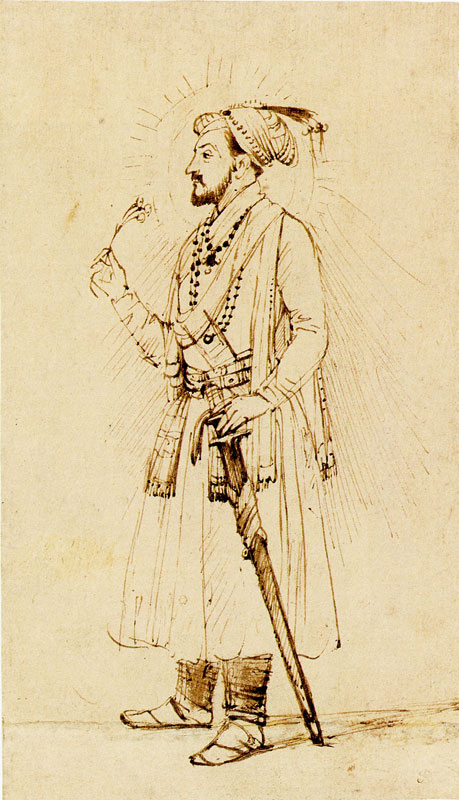
Shah Jahan, Standing with a Flower and a Sword
Item
-
Title
-
Shah Jahan, Standing with a Flower and a Sword
-
Creator/author/artist of the original item
-
Rembrandt van Rijn
-
Date
-
c. 1656-1661
-
Description
-
*Shah Jahan, Standing with a Flower and a Sword* is an ink drawing on paper by the Dutch artist Rembrandt van Rijn. This drawing shows Shah Jahan, the Mughal emperor who reigned from 1628-1658 and the commissioner of the Taj Mahal. Jahan is dressed in a robe, scarves, several necklaces, and a feathered and bejeweled headwrap. He has one hand resting on the hilt of a sword strapped to his waist. In his other hand he carries a flower, which he is looking at. Jahan’s head is surrounded by a halo and is sending light in every direction.
This work is one of more than twenty drawings made by Rembrandt which were based on Mughal miniatures. Wiesner-Hanks says that Dutch artists, but especially Rembrandt “showed deep insight in their work, capturing individual personalities often engaged in introspection” (396). In this drawing, although it is not one of Rembrandt’s standard portraits, I do think that there is a depiction of introspection through Jahan’s consideration of the flower.
This drawing is particularly interesting in how it relates to the Netherlands’ position in the world in the 1650s. The Dutch East India Company had been established in 1602 and begun to build and seize fortified trading posts in the vicinity of the Indian Ocean. In 1619, they had captured Jakarta, and by the time of this painting had seized many of Portugal’s outposts in the Indian Ocean (Wiesner-Hanks 500-501). The Dutch East India Company in this time period had been granted the right to trade in many of the Mughal Empire’s port cities, and through this relationship goods were flowing back and forth between the Mughal Empire and the Netherlands.
Although we do not know exactly from whom Rembrandt acquired the figures he based this drawing off of, his possession of Mughal artwork is indicative of the increased exchange of both material goods and ideas between India and Europe in the 17th century. He also did all of this series of drawings on paper imported from Asia, again showing the flow of material goods. Although Rembrandt is most famous for other works, this drawing is particularly illustrative of the way that colonialism affected the world of art. Rembrandt here is imitating and learning from the Mughal style of art, and fusing his own tradition of art with a tradition from an area of the world that his country was colonizing. This drawing is a good reminder of the way that colonial relationships brought about cultural exchange.
-
Place
-
Netherlands
-
Source Citation
-
Van Rijn, Rembrandt. *Shah Jahan, Standing with a Flower and a Sword*, c. 1660. Pen and brown ink with brown wash on paper. 17.8 cm × 10.1 cm. France, Fondation Custodia.
-
Rights / License
-
Public domain, via Wikimedia Commons