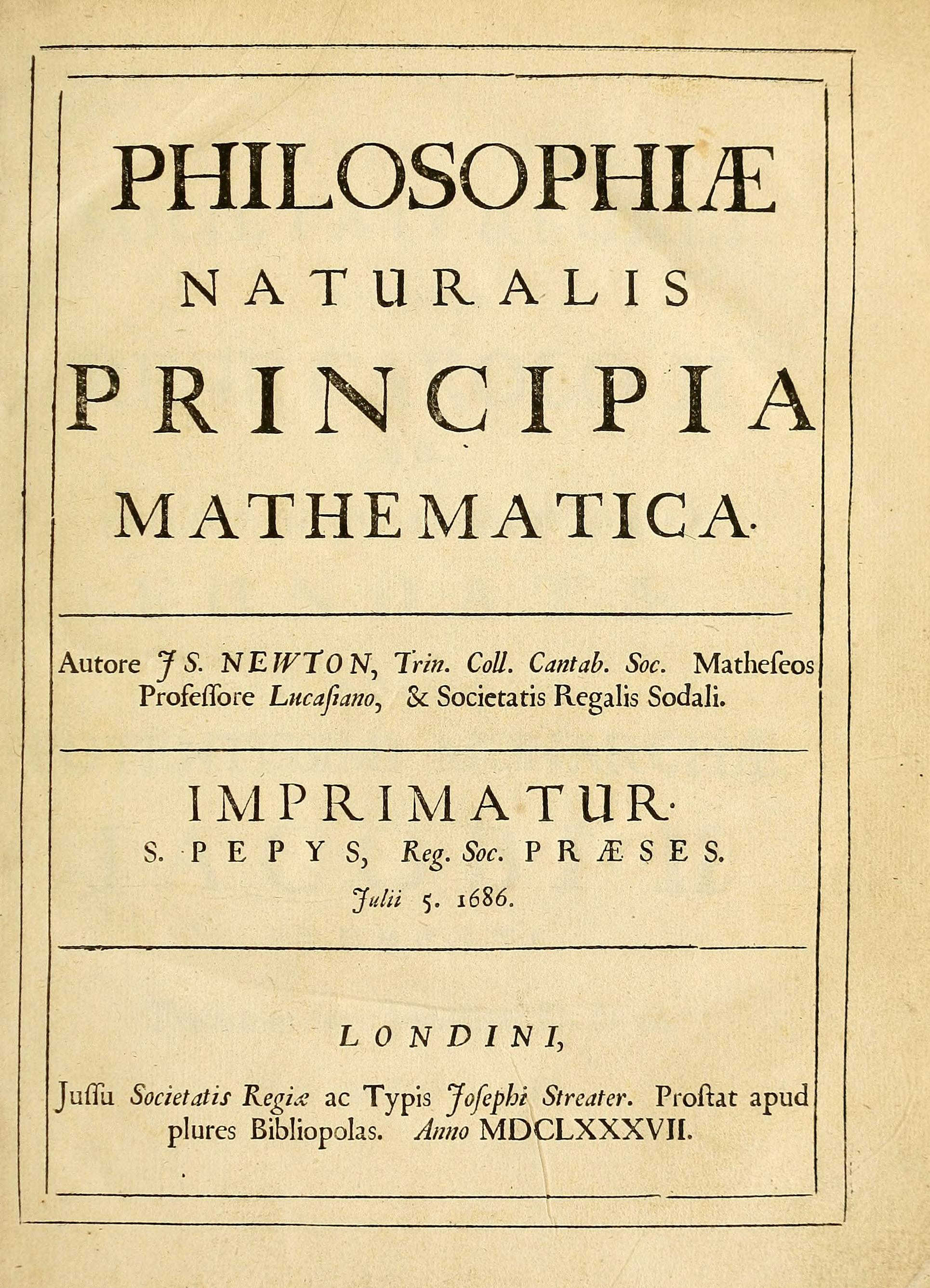
Philosophiæ Naturalis Principia Mathematica or The Principia
Item
-
Title
-
Philosophiæ Naturalis Principia Mathematica or The Principia
-
Creator/author/artist of the original item
-
Sir Isaac Newton
-
Date
-
1687
-
Description
-
Pictured here is the title page of the first edition of Sir Isaac Newton's *Philosophiæ Naturalis Principia Mathematica* (or *Mathematical Principles of Natural Philosophy*). It was published on July 5, 1687 and introduced Newton's laws of motion as well as his law of universal gravitation. Often simply called *The Principia* Newton's book comprises three volumes and was written in Latin. Newton had been a student, and then professor, of mathematics at Cambridge and had studied mechanics and cosmology, even building the first working reflecting telescope. In addition, Newton’s development of calculus set the foundation for the majority of modern engineering, physics, and mathematics. *The Principia*, however, was Newton’s most famous work as it brilliantly synthesized Kepler’s findings regarding motions in the heavens and Galileo’s discoveries about motion on earth into universal laws expressed in mathematical terms. Newton went on to be elected to Parliament multiple times and become president of the Royal Society. In the eighteenth century, his ideas began to be applied to the study of heat, light, magnetism, and electricity. It is also important to contextualize Newton’s achievements in the backdrop of the Scientific Revolution, a “time of change in the way learned individuals approached, conceptualized, and studied the natural world” (Wiesner-Hanks 385). This period saw people all over Europe inventing equipment that is still used in laboratories today (beakers and balance scales) while also experimenting with chemical changes and the application of alcohols and acids (often rooted in alchemy). The discoveries of Kepler, Galileo, and more served as major contributions to Newton’s ideas and it is crucial to note how the broader ideological shifts leading up to Newton included critical developments such as the English philosopher and statesman Francis Bacon’s formulation of the scientific method, a sterling example of the contemporary notions of empiricism and the rejection of dogmas.
-
Place
-
Cambridge, England
-
Source Citation
-
Wiesner-Hanks, Merry E. *Early Modern Europe, 1450-1789*. 3rd ed. of *Cambridge History of Europe*. Cambridge: Cambridge University Press, 2022.
-
Newton, Isaac. *Philosophiæ Naturalis Principia Mathematica*, London, Press of the Royal Society of London, 1687
-
Rights / License
-
Public Domain