Glorification of Commerce and Science
Item
-
Title
-
Glorification of Commerce and Science
-
Creator/author/artist of the original item
-
Jan Brueghel the Younger
-
Date
-
Between 1625 and 1649
-
Description
-
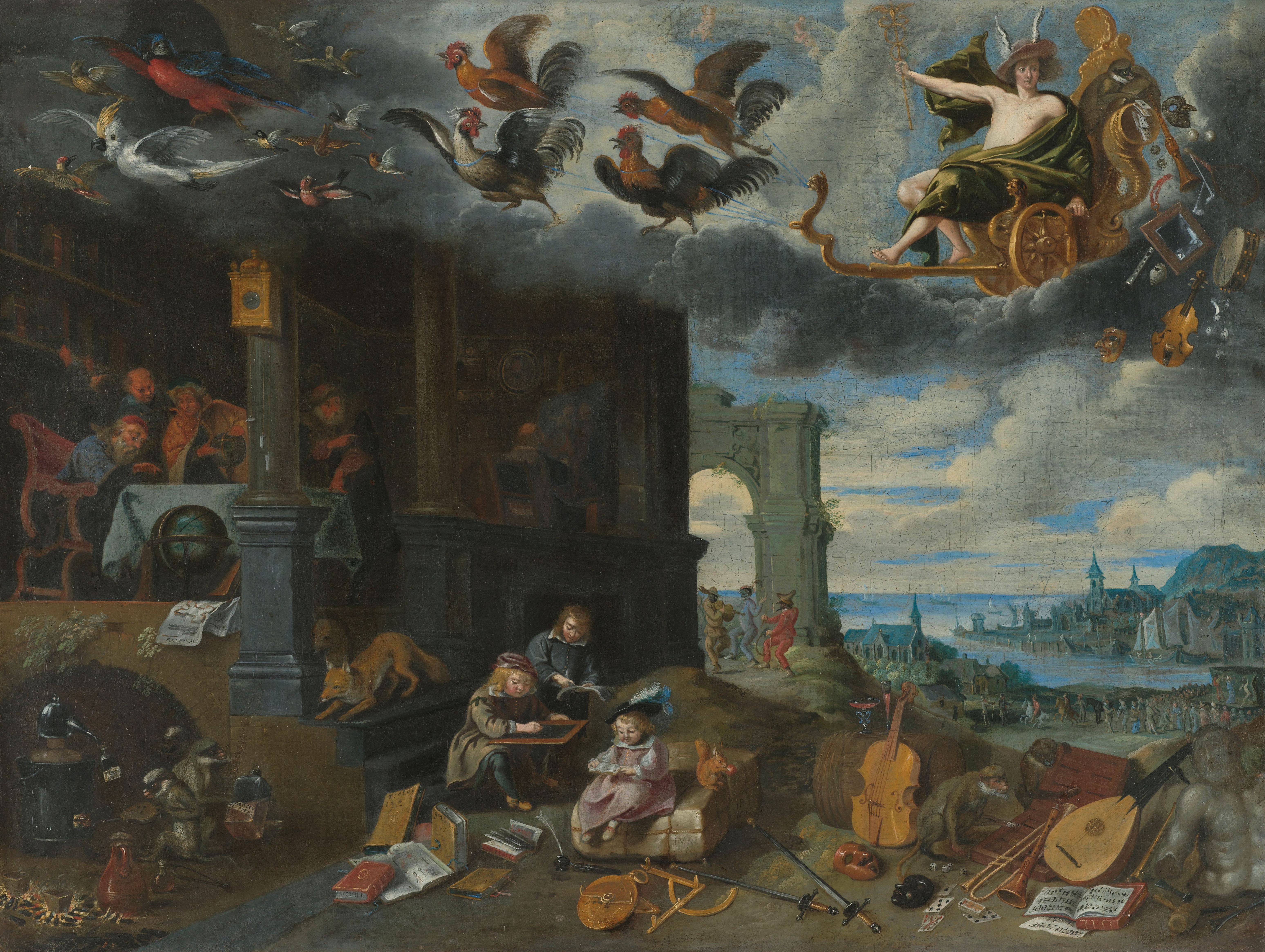
*Glorification of Commerce and Science*, also called *The Children of the Planet Mercury*, is an oil painting by Jan Bruegel the Younger, the grandson of Pieter Bruegel. In this painting, we have educated individuals studying and conducting science in the left and bottom, while in the background there is a harbor where other citizens watch plays and race horses. Above it all, the god Mercury is riding in a chariot pulled by various birds. Various instruments, sporting equipment, and games are being poured out of his chariot by a monkey.
Thematically, I think that this painting is contrasting diligence and diversion. We have scientists and children studying in the foreground, while in the background crowds of people are dancing and watching a play. In the bottom left corner we have monkeys doing alchemy, while in the bottom right we have monkeys playing dice, and the monkey in Mercury’s chariot is pouring means of diversion, like instruments and decks of cards, into the world.
This painting connects with our class material in that it shows a fascination with scientific instruments, the character of the scientist, alchemy, and the education of children. On the left side of the painting we can see a group of scientists huddled around a table, with an astrolabe and a globe nearby and papers on geometry and the building of fortifications in the foreground. Beneath these scientists, in the bottom left corner, we see three monkeys working an alchemical furnace in order to distill a brown liquid. At the bottom of the painting there are three children studying. On the ground nearby are several books in various disciplines. The books cover topics such theology, poetry by Virgil, medicine by Galent. This mixing of theological, classical, and scientific texts is a good reminder of Wiesner-Hanks’ point that the Scientific Revolution should not be characterized as a battle between religion and science (378). This is not to say that the relationship between science and religion was not something people in the period were considering. In the painting, there is a book marked ‘D. Faust’ among the children’s books. Faust was a legendary figure whose desire for knowledge led him to make a pact with the devil. It is hard to say what Bruegel meant by the inclusion of this book, but I might speculate that the legend of Faust showed an anxiety in society about the relationship between educated individuals, science, and religion. Societal preoccupation with figures like Faust helps explain some of the hostility that Galileo describes in his *Letter to the Grand Duchess*.
-
Place
-
Southern Netherlands
-
Source Citation
-
Bruegel (the Younger), Jan. *Glorification of Commerce and Science*, c. 1645. Oil on canvas, 70 cm × 92 cm. Netherlands, Rijksmuseum.
-
Rights / License
-
Jan Brueghel the Younger, Public domain, via Wikimedia Commons