Landscape with the Fall of Icarus
Item
-
Title
-
Landscape with the Fall of Icarus
-
Creator/author/artist of the original item
-
Pieter Bruegel the Elder or Unknown
-
Date
-
c. 1560
-
Description
-
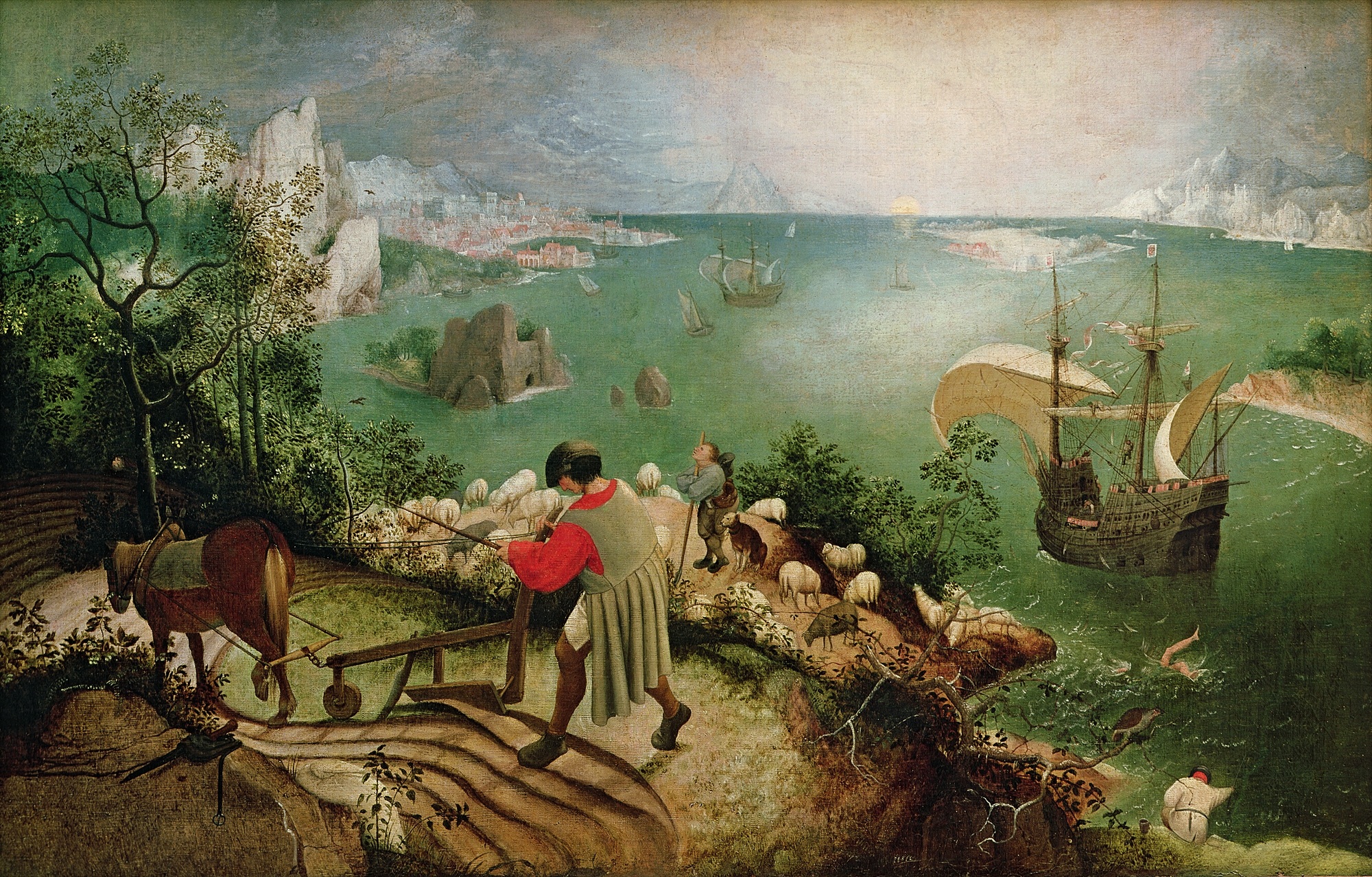
*Landscape with the Fall of Icarus* is a painting in oil on canvas painted either by Pieter Bruegel or an unknown artist copying Bruegel's original. The painting depicts the aftermath of the story of Icarus. In Greek mythology, Icarus is the son of the inventor Daedalus. He escapes imprisonment using wings made by his father, but in the process flies too close to the sun. This causes the wax holding his wings together to melt and him to plummet into the ocean and die.
What is interesting about this painting is that it does not center on Icarus - he can only be seen as a pair of legs floundering in the ocean on the bottom right. A nearby fisherman pays his drowning no attention, and the central figure is a peasant in the foreground, who is looking towards the ground. This peasant seems totally occupied with his work and ambivalent towards the drowning of Icarus. One might speculate that the theme is man's ambivalence towards the suffering of others. Such a theme would not be out of place in the 16th century Low Countries. Although the Eighty Years War would not start in Bruegel's lifetime, the Reformation had already hit the Netherlands. With sizable communities of Calvinists and Anabaptists developing, religious persecution was on the rise.
Throughout his career, Bruegel took peasants as his primary subject matter. This concern with peasant lifestyle and the peasant mind is interesting in that it follows not long after the German Peasants War. WIth the advent of the printing press, the concerns which troubled peasants could be written down and widely distributed. We see this in the Twelve Articles of the Peasants of Upper Swabia, in which peasants list their issues with their economic and political arrangements and give religious arguments against these arrangements (Baylor 76-82). These peasants were not 'keeping their eyes on the ground'. This is not to say that Bruegel had any political interpretation in mind. It is only to say that at the time, what sorts of things peasants should concern themselves with was an open and debated political question.
-
Place
-
Netherlands
-
Source Citation
-
Bruegel, Pieter. *Landscape with the Fall of Icarus*, c. 1560. Oil on canvas, 73.5 cm × 112 cm. Brussels, Royal Museums of Fine Arts of Belgium.
-
Rights / License
-
Possibly Pieter Brueghel the Elder, Public domain, via Wikimedia Commons