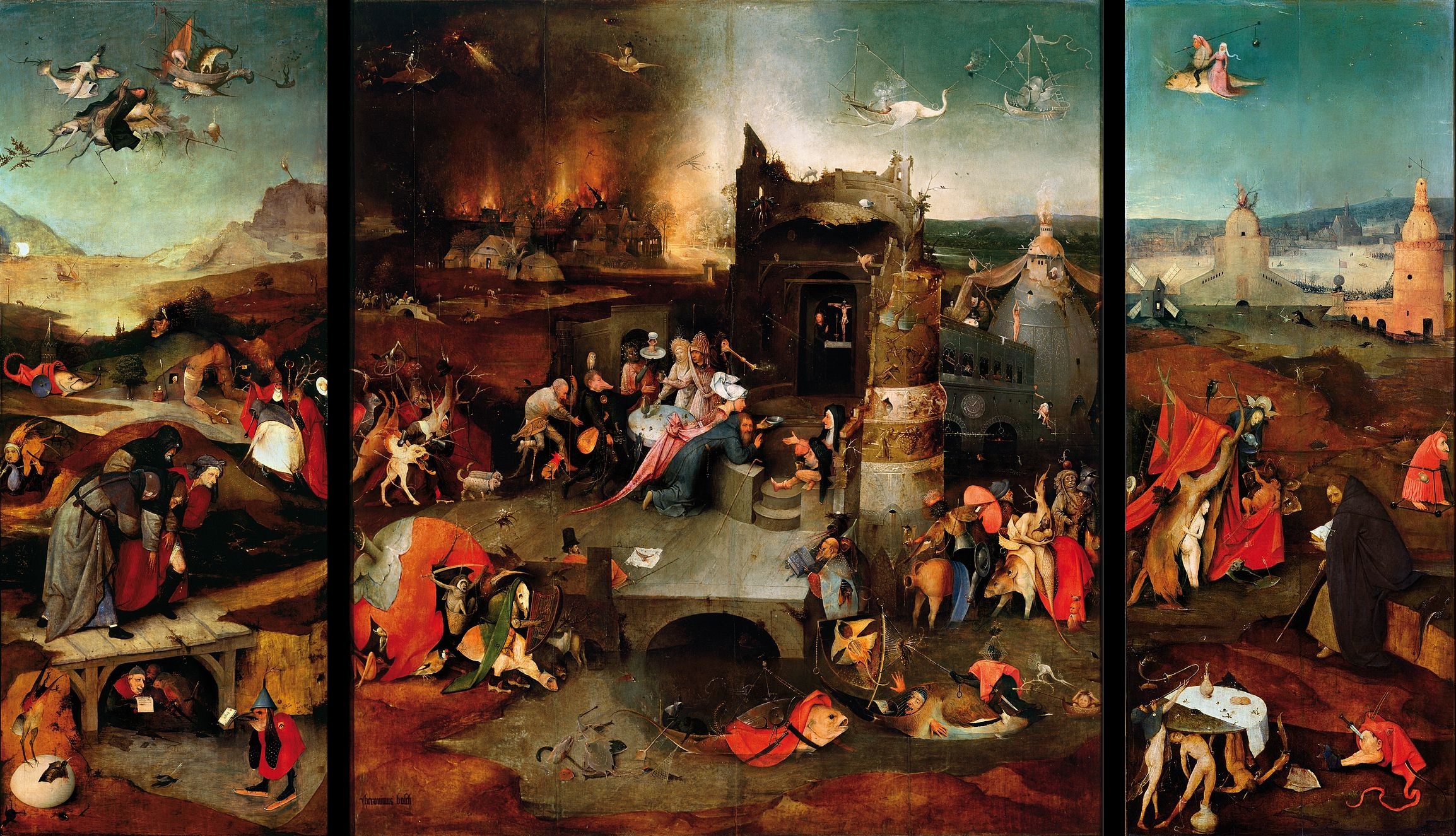
Triptych of the Temptation of St. Anthony
Item
-
Title
-
Triptych of the Temptation of St. Anthony
-
Creator/author/artist of the original item
-
Hieronymus Bosch
-
Date
-
c. 1500
-
Description
-
This piece is a triptych, a work consisting of three connected panels, made from oil on oak. It was made by Hieronymus Bosch, a Dutch artist of the Northern Renaissance.
The painting shows three scenes, each from the life of Saint Anthony. Saint Anthony was an early Christian figure, a man who left his worldly life in favor of a more spiritual life of isolation in the desert. According to legend, this movement into the desert led Saint Anthony to be harassed by hordes of demons.
This painting shows a concern with the abundant evil of the world, something that preoccupied the thoughts of northern 'Christian humanists'. For instance, in "The Praise of Folly" Erasmus notes the danger posed by "wicked prelates" (Wiesner-Hanks 142). In the left panel, Bosch draws a demon with the head of a stag, garbed in the robes of a priest. In the center panel, very near the praying figure of St. Anthony, we can also see a demon disguised as nun, and below this a rat-faced demon with the tonsured haircut of a monk reads from a book. These characterizations of religious figures as sinners or demons in disguise give us a window into the perspectives some people at the time had about religious figures, which contextualizes the emphasis on church reform of many Northern humanists.
The world Bosch depicts in this painting is one of ubiquitous evil, one where evil abounds in forms both open and disguised. This assumption is echoed by Vives in his “The Education of a Christian Woman”, when he argues that humans need “knowledge of good to protect us from the constant onslaught of evil” (63). In different ways, Bosch and Vives both depict authentic religiosity as creating an island of good within a world which is a sea of evils.
-
Place
-
Netherlands
-
Source Citation
-
Bosch, Hieronymus. Temptation of St. Anthony, c. 1500. Oil on oak, 1.31 m x 2.38 m. Lisbon, National Museum of Ancient Art.
-
Rights / License
-
Hieronymus Bosch, Public domain, via Wikimedia Commons