Judith and Holofernes
Item
-
Title
-
Judith and Holofernes
-
Creator/author/artist of the original item
-
Donatello
-
Date
-
1455
-
Description
-
Sculptors of the Renaissance around the 14th century were heavily influenced by the artists of ancient Greece and Rome, and often looked to them for inspiration as they carved their own works. While these ancient sculptures were created in workshops with many artists and apprentices working together, the Renaissance sculptor Donatello worked alone (Vasari, 189). He lived in the 14th and 15th centuries in Florence, Italy and was passionate about reinvigorating the beautiful traditions of ancient Greek sculptures. He reflected this in his sculptures through “spatial depth, dramatic scenes, classical themes and settings, expressions of weight and force” (Wiesner-Hanks, 160). He was especially concerned with depicting the natural world through idealizations. Artists of this time believed that the purest forms were found in nature, though they also acknowledged nature's visual imperfections. To compensate for this, artists would create an illusion of the natural world, disregarding its flaws (Wiesner-Hanks, 160). Donatello built upon the techniques of the ancients, breathed life into his sculptures, and idealized the natural form particularly in his sculpture of the Bible story of Judith and Holofernes. In 1455 the Signoria of Florence commissioned Donatello to make this bronze sculpture for it to be displayed in the piazza (Vasari, 179). The close relationship of religion and politics and the emphasis on Christian reformation resulted in a lot of religiously inspired art, especially when the art was commissioned by the government. This sculpture depicts Judith of Bethulia which was besieged by General Holofernes and the Assyrians. Donatello portrays the moment in which Judith decides to free her city by killing Holofernes. This sculpture expertly depicts the strength from God found within Judith as she stands up tall with her eyes gazing forward, frozen in the moment after she has brought down her sword on Holofernes’ neck. This feminine power is clearly contrasted with Holofernes’ limp body and closed eyes as he is overcome with death (Vasari, 179). Even in this moment of weakness however, Donatello depicts Holofernes with a sense of elegance, recalling the tendency of Renaissance artists to idealize their subjects.
-
Place
-
Florence, Italy
-
Source Citation
-
Vasari, Giorgio. “Life of Donatello.” In Lives of the Artists, translated by George Bull, 1:174–90. Penguin Books, n.d.
Wiesner-Hanks, Merry E. *Early Modern Europe, 1450–1789.* 3rd ed. Cambridge History of Europe. Cambridge: Cambridge University Press, 2022. doi:10.1017/9781009160797.
-
Rights / License
-
Yair Haklai, CC BY-SA 4.0 <https://creativecommons.org/licenses/by-sa/4.0>, via Wikimedia Commons
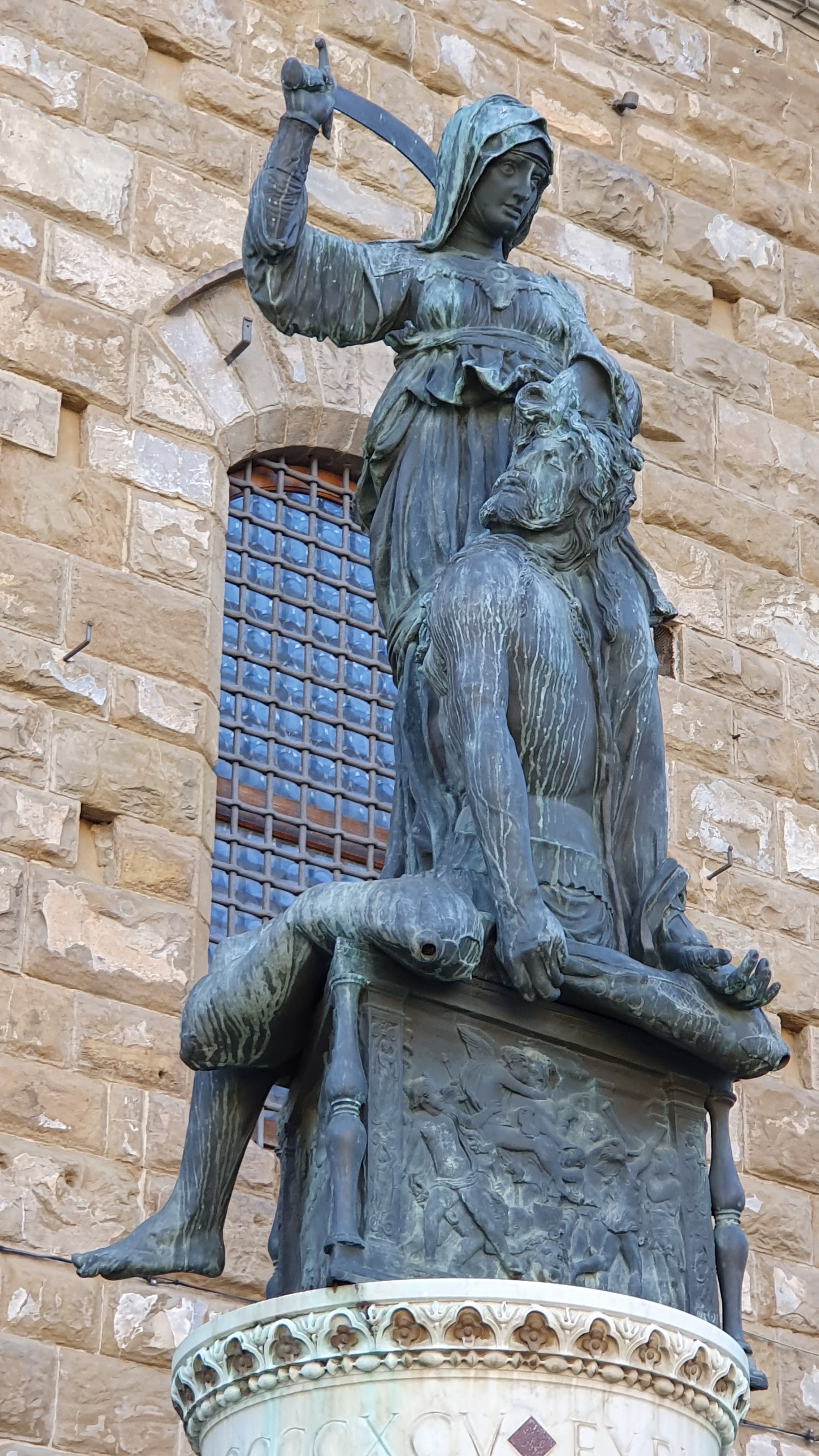
 Judith and Holofernes