Religion, Reformation, and Protestantism
The Reformation
The protestant reformation started early in the 16th century and was a response to the greed the Church exhibited around Indulgences and other property and tax-related policies. At the time, churches extracted Indulgences - small monetary donations - from members of their congregations, promising forgiveness of sin in exchange. The Reformation was largely initiated by Martin Luther, who believed in justification by faith alone, arguing against papal infallibility and many of the structured aspects of the church. Reformers believed that access to Heaven was caused solely by faith in Christ, and that mediation - especially financial - by the Church could have no bearing on the fate of the soul. Many of Luther’s followers and the protestants at the time found the Church to be deeply unfair and wanted to regain access to public and private properties that the Church controlled. His messages were also spread very easily by means of the newly invented printing press, which enabled pamphlets to be distributed around any city or town in a short amount of time. The Reformation led to many peasant wars, revolts, and violent conflicts between Christians and Protestants.
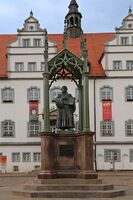
Martin Luther was born in Germany in the late 13th century. He was a priest, theologian, and professor. He was working in Wittenberg in 1517, when he finished writing his 95 theses against structures of the Church, and then posted them on the door of the Church there. His opinions caused great controversy, as he was deeply critical of papal infallibility and financial systems managed by what he viewed as a corrupt Church (though he was not critical of the Pope himself). Luther was against the system of Indulgences the Church had begun to rely on, and he viewed them as exploitative and unchristian. He believed in salvation by faith alone, meaning that an individual’s faith was the only determining factor in their soul’s fate after death. In 1521, Luther was sentenced to excommunication, as a consequence of his refusal to recant sentences from his 95 theses and several other works that were seen as heresy. While he managed to evade execution, the excommunication stayed in place for the remainder of his life (Wiesner-Hanks).
Credit to Scott Gevurtz
John Calvin was a French theologian, writer, and preacher during the protestant reformation. Though he was French, Calvin largely operated in Geneva, Switzerland, in order to safely develop his ideas. In Geneva, Calvin began to make use of the newly invented printing press, printing his books and pamphlets to be distributed around the city, as well as across the French border. The Reformation and the printing press gained popularity at the same time, and it wasn’t a coincidence; reform in the church had been going on for a long time, but the printing press was key in enabling it to become more widespread. Calvin’s beliefs were similar to Luther’s regarding the church, but he differed in his opinion about the fate of the soul. Calvin preached predestination, an idea wherein a soul’s destiny - either Heaven or Hell - was predetermined, and the events of an individual’s lifetime had no effect. Calvinism was very popular in Geneva, and eventually also became the most popular form of Protestantism in France, where Gallican liberties enabled people to practice religion more independently from the Pope. Calvinism also involved a lot of congregationalist “gathered churches”, where Church would be more of an informal discussion on scripture than conventional Church structures (Wiesner-Hanks).
Transubstantiation and the Eucharist was a practice which the Catholic Church preached wherein the literal body and blood of Christ were being consumed. They believed that the bread and wine had an innate inner essence of Christ, and the offering by a priest was essential to the effectiveness of the ritual. In contrast, Martin Luther - a priest himself - believed that while Christ had an innate presence in the elements of the ritual (the bread and wine), the presence of a priest to conduct the ritual had no effect on the presence of Christ. Luther was also very upset with the Church’s use of this significance of the Priest to manipulate members of the congregation. Taking it one step further, Zwingli, a Swiss reformer, believed that Christ was present among the faithful during the ritual, not in any way tied to the bread and wine. He thought that the bread and wine were simply a means of signification, an idea which led to several public written attacks from Luther. Over time, these different conflicting perspectives evolved into different denominations (Wiesner-Hanks, p. 179-180).
The Religious Society of Friends, or the Quakers, was an English radical reform Protestant group. In 1652, founder George Fox experienced a vision of God’s Spirit present in every person, which led to Quakerism’s values of equality across lines of gender, class, and race. Meetings took place outdoors or in simple meeting houses, and Friends exercised their beliefs outside of meetings by using informal pronouns for all people and fiercely opposing slavery and all external violence. Quakers’ worship revolved around the silent communal experience of God’s love, only sometimes featuring direct preaching or passages from the bible. Quakers believed that “the essence of the sacraments is inner washing, nurture, and Christ’s real presence in worship,” making the Eucharist and its physical components superfluous (Barbour).
Bibliography:
Barbour, Hugh. “Quakers.” In Encyclopedia of Religion, edited by Lindsay Jones, 2nd ed., 11:7546–50. Detroit, MI: Macmillan Reference USA, 2005. https://link.gale.com/apps/doc/CX3424502559/GVRL?u=mnalmgl&sid=bookmark-GVRL&xid=f7c2678e.
Cross, F. L., and E. A. Livingstone. “Calvinism.” Oxford University Press, 2009. https://doi.org/10.1093/acref/9780192802903.013.1129.
Wiesner-Hanks, Merry E. Early Modern Europe 1450-1789. Cambridge: Cambridge University Press, 2023.
Work on this page credited to Julia Tassava, Chris O'Mara, Kiera Block, Tabitha Jones, and Scott Gevurtz. See complete Bibliography for all sources used in the Religion exhibit.